
By Seán C. Malone and John Sweetman
I suppose Seán’s story of the “Turtle Rock” might have begun years ago when we both lived in the obscure eastern Washington town of Republic.
I had been the mill manager of the Day Mines for a time. It had been one of the only gold mines allowed to operate during World War 2, as it was so rich in vital ore. That was when gold was $32 an ounce. Later, it became one the most productive mines in the country as Hecla Mining took it over in the mid 80s.
Hecla Mining was basically a Wallace, Idaho silver mining company with no experience at all in gold mining. Their mine in Wallace was named “The Lucky Friday,” and they sure were lucky in Republic as they looked over old drill logs and found that the early miners had missed a deposit that returned well over 2 million ounces of gold in what they named “The Golden Promise.” I personally saw nearly pure epithermal gold ore come out with large visible lumps from the 2,000-foot underground level.
Naturally, Seán and I reverted to our much earlier gold-seeking days since I had panned gold with my mom on the Cispus River in Lewis country, to little avail, and Seán has even tried panning gold on Vashon! And so, we looked for gold ore outcrops while pursuing other activities in the Colville Forest, not so much for profit but as for fun. Both of us were out in the rugged country looking for wood, hunting, and me looking for my lost cows on the range.
We eventually staked over 30 claims in that area and actually found enough modestly high-grade locations to lease our claims to the Hecla Mining company for what we considered a small profit … some of the “profit” was dissipated in a bottle of Laphroaig Scottish malt whisky.
But the good thing about our claims was the side benefit of finding some fine firewood, and then Seán actually found an abandoned raven chick that became his good companion until he crapped on Seán’s vintage TV that never worked well anyhow … and it blew up.
In addition to the finding of the raven, we also ran across ledges of fossils from what was identified as the “Klondike” formation. An old Miocene lakebed that had fish … dawn redwood … gingko, and numerous bugs in thin layers of old clay bottom.
Turns out, these fossils became well-known and distinctive, and today there is a small center in Republic devoted to them. Some of its samples came from our collection. The center is called Stonerose, after numerous fossils of this early rose were discovered and sent to the Burke Museum.
It did help that Seán was a caretaker of a mine at the time, and he discovered a ledge of the deposit that was detached from the rather elusive main body and yielded some unusual examples of early birch seeds. My main contribution, among others, is displayed as a rare type of “stinkbug.” Indeed not impressive, since after 45 million years, they have come back to Vashon in force.
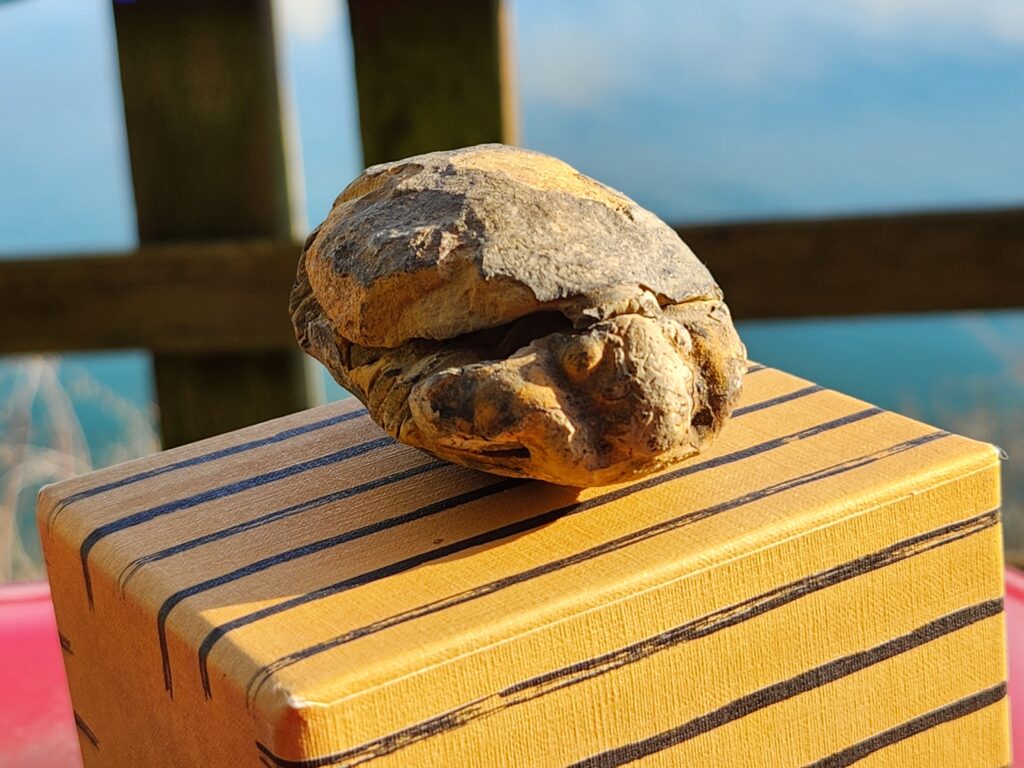
So, Seán was pleased to see a new fossil appear as a gift from brother Mike, this Christmas, naturally. I think this gift will appear in the coming rock show at the historical society. He claims it’s a “turtle,” but it could be a mutant clam. I go for the turtle explanation. We are not going to contribute our high-grade gold samples from our prospecting days to the event …
Seán tells the story of his “turtle” fossil.
Grandma Ada and Papa Jim had 23 grandchildren living on Vashon, most near Portage. Grandma Ada was Danish and her father was a naturalist doctor who had gone back to medical school in South Dakota to become accredited in this country. After that, he purchased some property at Portage and moved his considerable family there in 1892. Fast forward 60 years and you have Papa Jim winning the clam-digging contest, sponsored by the Vashon Sportsmen’s Club.
In fact, our grandfather won the clam-digging contest several years running, until the Sportsmen’s Club presented him with a gold cup that declared him the World Champion Clam Digger. He never used a shovel, though. Papa Jim’s tool of choice was a cultivator with five eight-inch long tines. His secret was to drag the cultivator through the gravel to find the Littleneck or Butter clams, his favorites for steaming. The other competitors dug holes in the sand down the beach toward the tide.
It was in 1952 that Papa Jim made a find on that same Tramp Harbor beach across the road from the Portage store. His prize find was a 3-inch petrified turtle that could be over 250,000 years old.
My Brother Mike gave me that fossil for Christmas. I’m wondering if this fossil has commercial value? Brother Mike pays me $5.00 for every rat I trap at the homestead.
Well, this “turtle” find gives us more hope when we are beachcombing these days. For one thing, fossils are easier to carry and not as heavy as the neat pieces of driftwood we used to carry home.
