
By John Bean
In “House of the Dead,” Fyodor Dostoevsky reveals his conviction that the quality of a civilization can be judged by how it treats its prisoners. If you believe in a strongman society ruled by force, then prisons might look like El Salvador’s notorious CECOT – a site for Kristi Noem’s appalling photo-op in front of caged prisoners. In contrast, if you imagine a society that honors human rights and is marked, even occasionally, by love of neighbor or compassion or kindness, prisons might resemble those in, say, Norway or Finland, where guards and staff respect the dignity of prisoners and where the goal of prison life is rehabilitation. It is said that in Norway, “People go to court to be punished and go to prison to become better neighbors.”
This contrast between force and kindness has been on my mind lately as our Episcopal Church Outreach Committee thinks about prison reform. For the past three years, we have mounted projects to oppose mass incarceration. In Washington state, the driving cause of mass incarceration is the 1983 Sentencing Reform Act with subsequent amendments, which reflects the 1980s mindset of “hard time for hard crime.” The Reform Act mandates long sentences, often beyond the demands of justice, focuses prison life on punishment rather than rehabilitation, and disproportionately targets communities of color. Despite evidence that offenders age out of crime and despite enormous cost to the state, our laws needlessly incarcerate persons who could safely and justly be reintegrated into their communities.
Currently, there seems to be no public momentum for system-wide revision of our criminal justice system. Progressive legislators must resort to piecemeal reform bills such as limiting solitary confinement or reducing prosecutors’ use of weapons enhancements, but these bills get little press coverage or public attention. In recent years, our Outreach Committee has lobbied for several of these bills by organizing informative webinars and following up with letters and phone calls to our legislators. But none of these bills even reached a floor vote.
Given our state’s commitment to human rights, why isn’t there more public pressure for prison reform? A common answer is that legislators – even the most progressive ones – don’t want to appear soft on crime. But there may be a deeper psychological reason worth exploring. From my observations, an underlying cause for public hesitation on sentencing reform is the fear that violent offenders are public threats forever. This is the “myth of the monster” that fuels mass incarceration. Many people are OK with reducing prison sentences for non-violent offenders. But not so with violent offenders, whom we tend to dehumanize as irredeemable “others” hardwired for crime, untouched by pangs of conscience, incapable of change.
The impetus for prison reform, I now think, depends on a society’s belief in the inviolable worth of all human beings. This belief might come from a religious tradition (we humans are made in the image of God or possess an inherent Buddha nature) or from non-theological rationalism (Kant’s injunction never to treat another person as a means to an end or secular humanism’s belief in inviolable human rights).
Perhaps a way to build momentum for prison reform is to share stories of people who have formed networks of love and care to help incarcerated persons turn their lives around. I have had the opportunity to observe two such networks. The first is Vashon-Maury SURJ (Showing Up for Racial Justice), which brings white people to stand in solidarity with minority families impacted by our carceral system. Members of SURJ create a supportive presence at re-sentencing hearings, actively write letters of support for clemency cases, and do the work of making personal connections for social justice.
Through SURJ, I learned about another network, “Families Shoulder to Shoulder,” founded by Tacoma reform activist Ginny Parham. How this organization got founded is the subject of a remarkable documentary, “Pathway to Freedom,” which has made a lasting impression on me. It shows Parham’s tireless persistence and love during her campaign to secure her son’s release (after 25 years) from a 96-year prison sentence. Her advocacy for her son helped her build communities with other families with incarcerated loved ones. The film also focuses on two incarcerated persons with remarkable integrity, courage, and resilience – Willy Nobles (Ginny’s son, who killed someone in a gang shooting when he was 18) and Marriam Oliver (who committed her violent crime at age 14). The film shows how they transformed their lives in prison, revealing why people cannot be defined by their darkest moments.
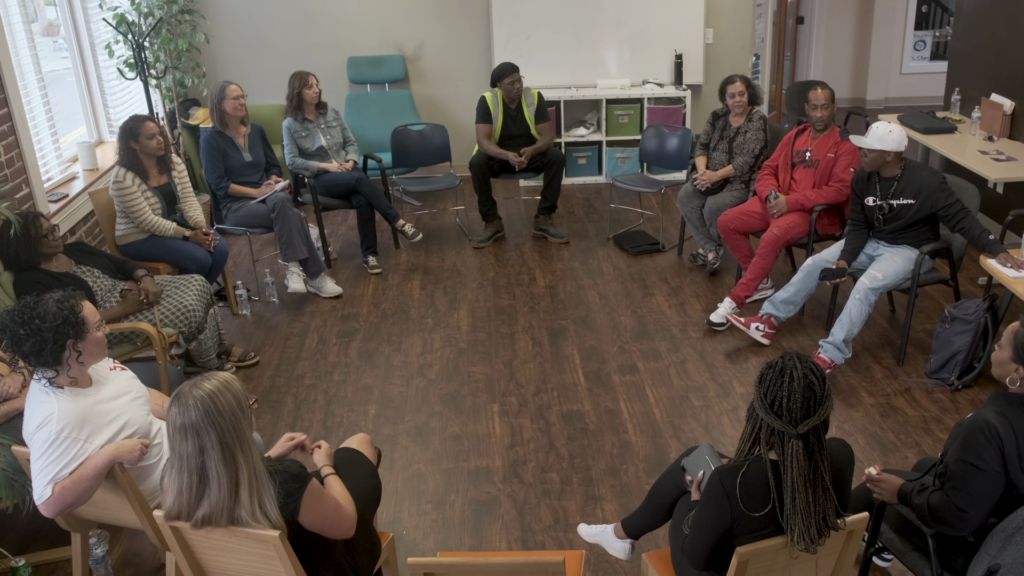
Discussion of this film led our Outreach Committee to decide our next project – to invite Ginny Parham and Willie Nobles to Vashon for a screening of Pathway to Freedom. Because the film is short (about 25 minutes) it leaves room for panel presentations and interactive discussion of prison reform. A member of SURJ will be on the panel, as well as a defense attorney from the “End Mass Incarceration” project. We invite the Vashon community to join us for this event and help build momentum for comprehensive prison reform that signals a kinder nation.
This prison reform event with film screening will be held on Sunday, February 22, 2:00 p.m. at the Land Trust Building.
John Bean is a retired professor of English at Seattle University and also a member of the Outreach Committee at Vashon’s Church of the Holy Spirit (Episcopal).
