Upcoming concert news and reflection, and a nod to a Seattle early music luminary
By Jane Valencia
“I have news for you!
The stags bellow,
the snow of winter falls
Summer is no more.”
~ From a 9th c. Irish poem
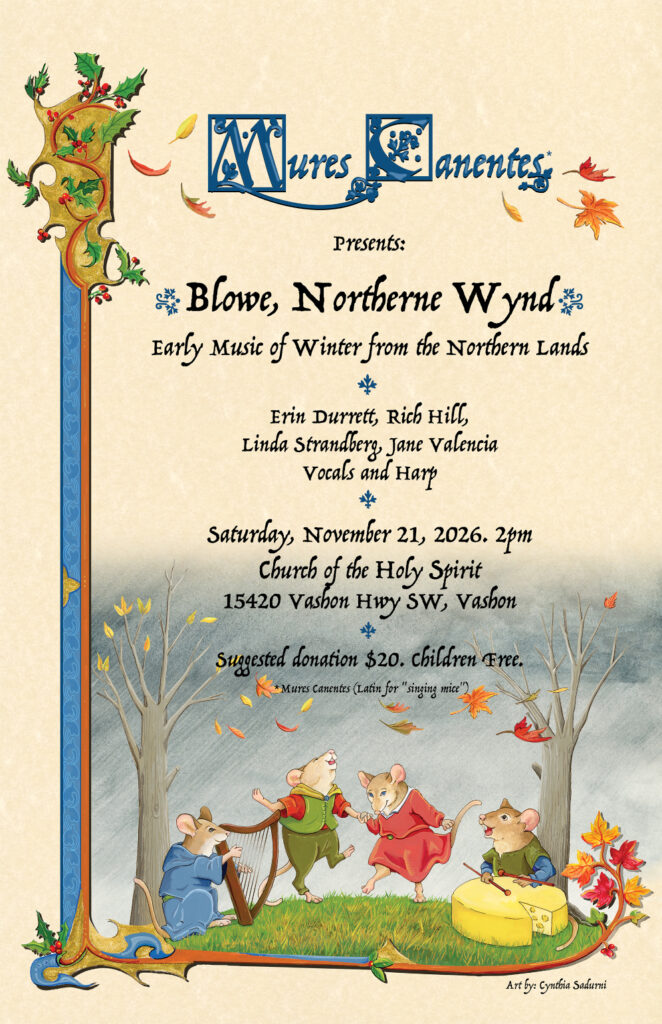
On Saturday, November 21 at 2:00 p.m., Islanders have a chance to savor fall’s passage into winter in a concert of medieval music with the vocal and harp quartet, Mures Canentes (Latin for “singing mice”).
The music featured includes several Celtic pieces – Early Irish poems, a lullaby in Old Welsh, some songs in Scots Gaelic, some from Hildegard of Bingen, and several pieces honoring St. Nicholas, who was a hugely popular saint for many centuries, including during the medieval period.
Allow me to introduce you to the “mice:”
Richard Hill performs each year on the Island in the Celtic band Keltoi, and is a Scots Gaelic language speaker, teacher, and vocalist. Erin Durrett is the music director for Vashon’s Church of the Holy Spirit and a chant specialist. Linda Strandberg is a cantor and psalmist at St. James Cathedral in Seattle, a section leader, and sings in the Cathedral choir. Outside my Loop involvement, I play and teach Celtic harp, and pursue the bardic arts.
In the quiet of the church, we pause in our music practice to converse about the concert. What is it about?
Erin explains, “Late autumn and winter are the theme. It really is meant to be a meditation on winter stories and a time for people to just take a breath and enjoy the moment of coming into the real season of winter before all of the chaos of Thanksgiving and Christmas takes over.”
Rich notes: “I think it’s really wonderful that we’re doing both pagan and Christian music. The Cailleach is pretty pagan. She’s the old mother of winter.”
Erin agrees. “Winter mama. And that kind of was our idea in having her as our mother of winter and Nicholas as our father of winter, because a lot of people are familiar with him in connection with Christmas, in connection with sleighs and snow and winter time.”
“Stockings and wooden shoes, and putting gifts in stockings,” Rich continues, “I keep thinking of this program as perhaps a look at winter in Ireland in the year 1200. Much pagan Cailleach lore would still be alive in Scotland and Ireland in that period. (It still is!) And after the conquest of England in 1066, the Normans came over to Ireland and brought their language. So culturally you’d have strata of Gaelic, Latin, and now French. What music would you hear if you were wandering in Ireland in 1200 AD? From village to church to castle to monastery, it would be this concert: stories and songs about Old Woman Winter, the birth of Jesus, and the miracles of Saint Nicholas.”
As we’re a new ensemble, I’m still getting to know how my three colleagues came into this music, and, consequently, met each other. The common “root” is in the person of medieval music specialist, Margriet Tindemans, legendary to the Seattle early music scene since her arrival in 1986. Having passed away in 2014, she is regarded with deep fondness and highest respect to this day.
Linda notes, “Magriet and her group Sequentia had put medieval music back on the map. She was not only a very strong performer, but also a scholar.”
Linda had pursued early music as a student at University of Southern California. “I always admired really strong melodies, really strong tunes. I always thought anything that endures that long has a certain kind of merit. When I moved back to Seattle, I was lucky enough to work with Margriet.”
Erin and Rich met each other in the late 80s by way of the University of Washington’s Collegium Musicum, an ensemble of singers and early music instrumentalists. The Collegium was led by Margriet.
Intensely interested in Gregorian chant at the time, Erin had sought a university that had a Collegium. “I was super-excited when I realized that the University of Washington had one.”
Rich joined at the urging of historical percussion specialist, Peggy Monroe.
In time, both Erin and Rich became involved with the Medieval Women’s Choir in Seattle, which Margriet founded in the early 90s. Rich and Linda too met by way of the UW Collegium and the Medieval Women’s Choir.
Rich recalls, “I can remember one concert where Linda and I sang, and she was Mary and I was the Risen Jesus, coming out of the tomb.
“I sang a couple of Angel Gabriel roles and Jesus a couple times, and Samson. And Margriet said, you’ve done all the big medieval roles, what’s next?”
Erin continues, “Margriet just opened door after door. A door Into early English music and a door into early French motets, cantigas, troubadours – the doors were just endless and incredible, fascinating and beautiful.”
Rich agrees, “Margriet was an amazing teacher. I learned more from her about so many things. Medieval performance practice and poetry and music. How to perform concerts. It was a fantastic education, in so many ways about so many subjects.”
Including the music of 12th century German abbess and composer, Hildegard von Bingen.
Before Margriet founded the Medieval Women’s Choir, Linda had sung with an small ensemble of women led by Margriet. “We started right off with a lot of Hildegard. She was a champion of Hildegard.”
Regarding her own love Hildegard’s music, Linda notes, ”it was basically from Margriet that I got the fervor.”
Two of Hildegard’s pieces are included in the upcoming concert.
“’Aer’ and ‘O Frondens Virga,’ Linda says, “are, in a way, anthems in my book. They’re somewhat simpler in the range and somewhat shorter than a lot of Hildegard’s songs, and are more accessible, especially ‘Aer.’”
“And I love ‘O Frondons Virgo.’ It’s so beautiful. I especially relate to it because of the aspect of nature and spirituality and greenness and her whole concept of viriditas, which is creating power and creative power.”
My own road to early music came from a different path, but with a similarity or two – a collegium musicum and a plunge into early music and things medieval in a university. Heading overseas to study medieval Welsh, then coming back and taking up the Celtic harp. Then off into the adventure of performing with harp, story, and song.
In the past decade Erin and I, the “country mice,” have collaborated on several musical projects, including a concert of Hildegard’s music. I’ve had the joy of learning Scots Gaelic song from “city mouse” Rich. And I delight in getting to know “city mouse” Linda, with whom we share a surprising thing in common – we are both former oboe players.
My love of medieval and Celtic languages and music continues, and has found a pleasant hearth with the three other mures.
Do come join us if you can, to enjoy some music, tales, and good company to warm us into winter, before any cold can take hold.
Attend the concert: WHEN: Saturday, November 21, 2:00 p.m. Doors open at 1:30 p.m. WHERE: Church of the Holy Spirit, 15420 Vashon Hwy, SW. Suggested donation: $20. Children free. Some arts and crafts will be available for purchase.