
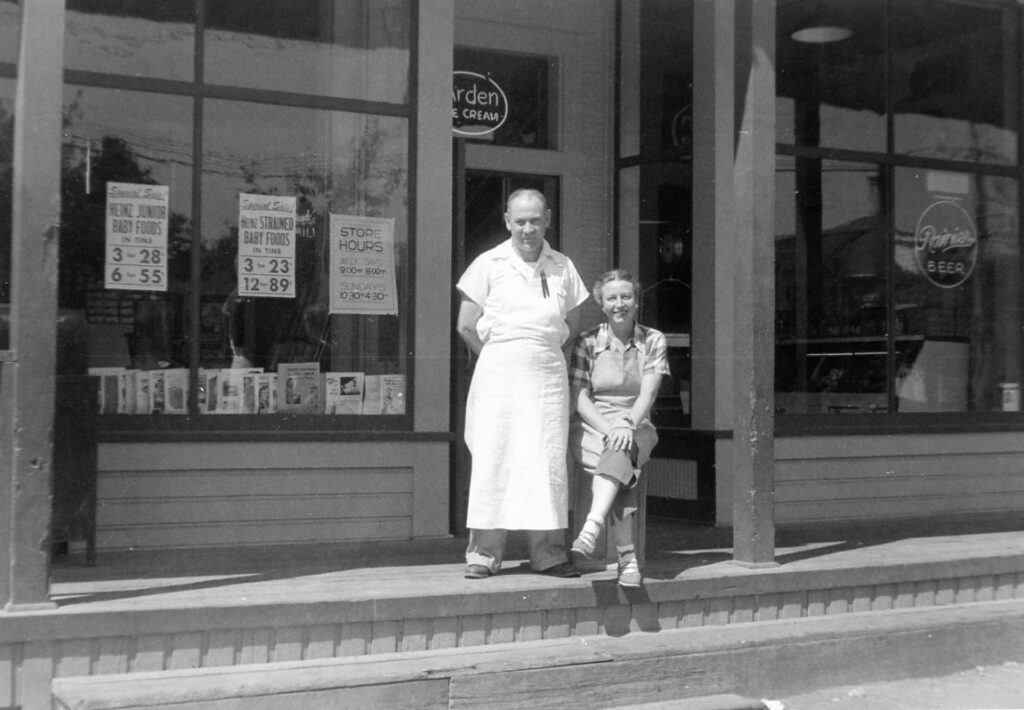
Courtesy of Candace Brown
Photographer: Howard Willsie
By Richard Odell
Did I imagine Daisy’s? My father liked to circulate. He had me in tow, at age three or four, deep in the 1950s. I remember an interior scene where today is Minglement. The presence of several adults, their voices like treetop murmurs above me. Canned goods lined on shelves which rose high upon the wall. I would someday learn this old-time arrangement of grocer’s items would give rise to the baseball phrase, “can of corn,” meaning an easily caught fly ball.
I came away thinking I had been to “Daisy’s,” but since no such local appellation has survived the ages, I had come to doubt my memory. But now my friend and classmate, and local history buff, Mike Sudduth, has solved the case, having sent me a photograph, via Candace Brown, of Tige and Daisy Leamer outside Leamer’s Shopping Center. They look able, bright, and content with their enterprise – an enterprise not long for the world.
Gone, too, as the supermarkets arose, would be the other wayside concerns: Franke’s at the North End; Mackie’s, aside Beulah Park on the Westside; Jack’s Corner; Lavender’s (later the Portage Store); the Tahlequah and Dockton stores. The whole lot, with their wooden floors, rattling, aged coolers, and their rusting signage for Hire’s, Nesbitt’s, and Carnation, would wink out one by one, though the process of elimination took years.
It was only Franke’s Cash & Carry, the one concern that might have survived, as the ferry lines grew past its door, that buckled and fell more or less in one act.
Ralph Franke, a broad-set man who spoke through a moustache, lived in a farmhouse on the bluff atop Parking Lot Hill. One night, he took his rifle out to the barn, bent upon some troublesome raccoon, yet through confusions, misalignments, and plain hard fate, the bullet breached the wall of his house and found his wife, instead. They managed to commune a short while, the two of them, in the hospital before she died.* (*Vashon Island News Record)
I never heard of it at the time. I was small, and the talk went over my head. But sent down the hill, one day, for a loaf of Wonder Bread, I found Franke sitting in the sun outside his store, his head bent down and a bottle on the ground beside his chair. He waved me away, groaning incoherently, before I got too close, and I went home and told my mother of the strange encounter.
Some days later, possessed of a dime, I sought to buy myself a pair of Hostess Twinkies – yes, a mile downhill and back, on foot, for a Hostess Twinkie – but Franke, nodding on his feet behind the counter, shoved the package at me for free. I had no idea, of course, of his torturous fix: possessed both of life and inventory which in his eyes, now, held no value, and perhaps searching, through his clouded grief, for some anodyne through alms.
Soon abandoned, the empty blockhouse store was parted out by intermittent waves of scavengers. The last wall came down maybe 15 years back. Today, a couple of electrical transformers and some deer-chewed cypress mark the old site, just off the highway. A series of long-haired freaks would occupy the farmhouse Franke had either lost or quit, and Franke took to walking the roads in an end-stage that went on for years, such that even this once small boy would wind up, someday, giving him rides in my car.
He might have had regular matters to attend to in the city, for often one found him scaling the main highway near the ferry, past the relic of his store. I don’t recall, from our car rides, any scent of alcohol, only the damp redolence of long and impoverished solitude emanating from the dark torso that blocked all light from that side of the car. Always, as the ride neared its end, somewhere in town, he’d ask if I’d ever seen a copy of a newspaper from the day President Garfield was shot. I’d say no, of course, and from his shopping bag he’d bring out a copy of Leslie’s Illustrated, with the shocking news, as promised, and thus the ride was paid for by Franke’s one last stock in trade.
His heart grew weak, but still he would climb the hill from the ferry in slow, hard-won steps, as though he were about to die on Everest. Subsequent boatloads of the Island’s ever-swelling commuter class would pass him by, until one among the few drivers who still knew him came along and opened a door, and until there were no more hills to climb. A remnant of his farm yet remains.
God rest his soul.
