By Andy Valencia
The Loop received a question about all those double power poles you’ve been seeing for years along Vashon Highway and other roads on the Island. It’s twice the visual impact, and how hard can it be to switch to the new pole and remove the old one? Why are the old ones sticking around so long?
You asked, so we asked. When we reached out to our PSE media contact, we ended up on a conference call with the people at PSE who work on such things. Stop and look up at a power pole, and appreciate that every single detail is intentional – the pole, how and where it’s installed, and every single wire and cable attached to it.
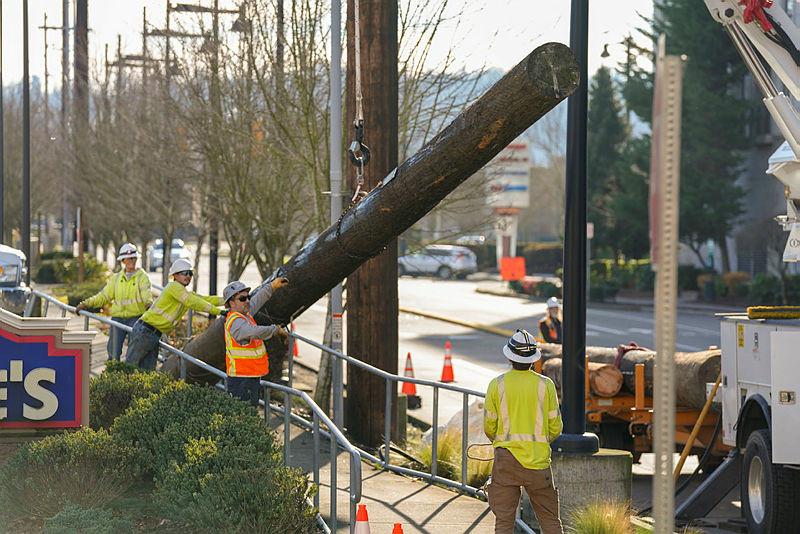
Start with the pole itself. There are many kinds, but on Vashon they’re mostly made of treated wood, weighing between 1,000 and 2,000 pounds. When you see PSE arrive and do an emergency pole replacement – such as when a car hits it hard enough – PSE is spending thousands of dollars to get the old pole out and the new one into service.
When we build a house on Vashon, there’s an exacting process of documenting the work in order to receive a permit. When it isn’t an emergency, the process of putting up a pole goes through its own permitting process – designing, engineering, and documenting every aspect of each pole to be added or changed in the project.
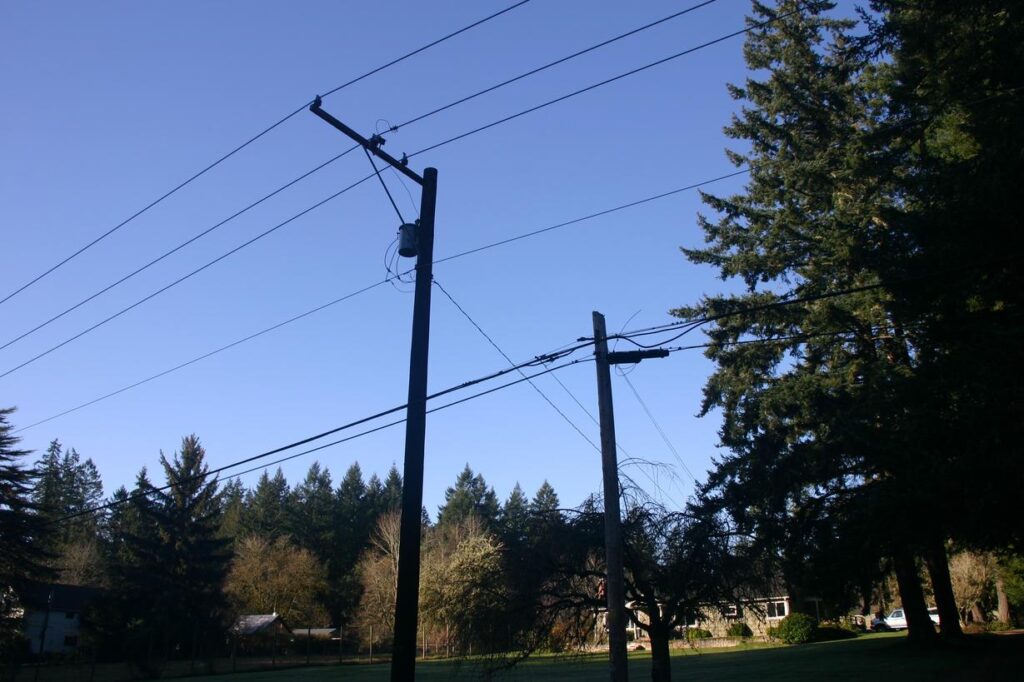
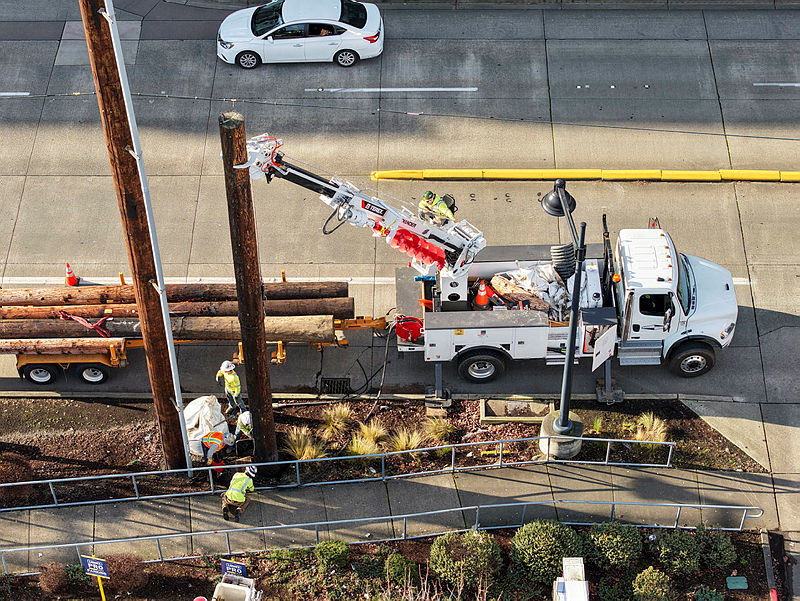
Why does PSE end up with so many double poles? PSE’s recent work relocating poles further back from our local roads is a perfect example of the challenges. Once the new pole is in place, everything on the old pole has to move over. There are high tension wires up top, and then further down are residential power wires, fiber optic cables for internet, phone lines, street lights, and sometimes even wireless devices.
Many of those non-power services were installed years or even decades ago. Contacts are out of date, corporate departments have morphed or disappeared, and sometimes the wires up there are barely earning their keep–or running at a loss. Even when you can reach the right person, the motivation to deploy a crew to do the wire work can be … minimal.
There’s a strict order to the moving of wires – whatever is at the top of the pole moves before anything beneath. Thus, the highest-voltage wires up top will move over first. Once they are moved, the pole is cut off above the next thing down on the pole. An internet service might be next, after which the contractor cuts the pole even shorter. You can watch the progress by the successive topping of the power pole. When the last service is moved, the remainder of the pole is taken away.
There’s a national registry to coordinate this work. As each service is moved, they mark completion and the next service is notified. Real life is messier; the work might be endlessly delayed, or the contractor does the work but doesn’t enter the completion mark in the system. Or the next service has broken contact information and doesn’t hear about it.
PSE kicked off an initiative to catch up. Of the roughly 5,000 poles on Vashon, there were more than 100 double poles standing. By the time of this interview, about a third of those have now been removed, more removals expected in the near future. In addition to the actual wire work, PSE has to send people over to visually inspect every pole, updating their database to reflect reality.
I asked if PSE has an “old poles home” where poles stand about on an empty hill and share their stories. In reality, the poles are considered treated wood, and are safely processed in cooperation with King County Waste Management. Alas, no retirement home, nor even a power pole museum.
If you see a double pole situation, PSE welcomes you to make sure they know about it. Note down the the identifier labels on the pole, along with the nearest street address. Send it to editor@vashonloop.com and we’ll pass it on to them.
Many thanks to our PSE media relations contact, along with the PSE pole services manager and one of their top pole trouble shooters.