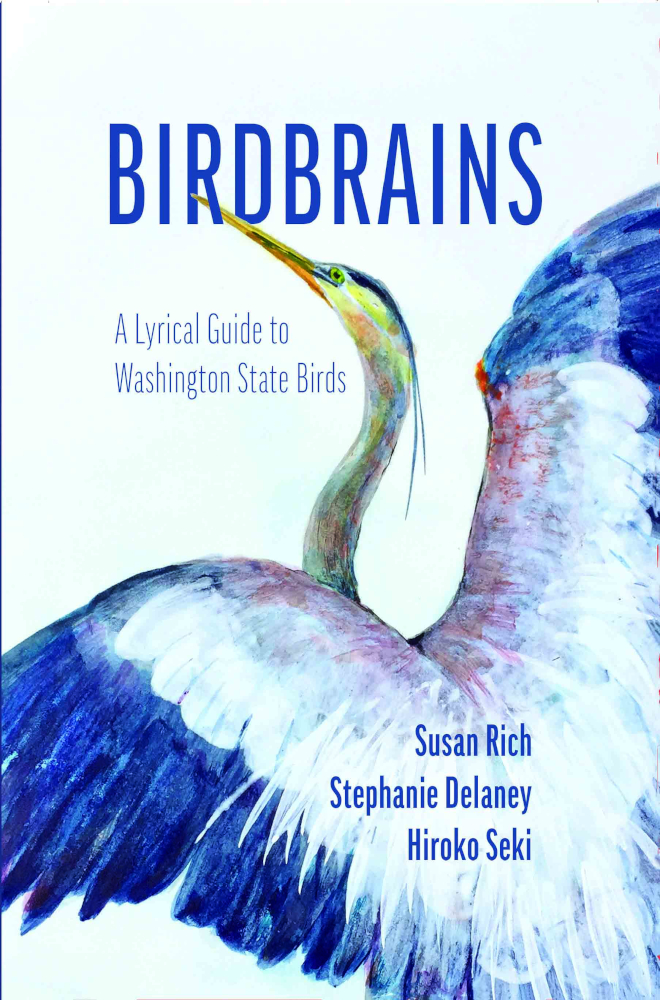
A Lyrical Guide to Washington State Birds
Birdbrains: A Lyrical Guide to Washington State Birds, edited by Susan Rich, is a one-of-a-kind Washington State bird guide. The anthology includes original pen and ink sumi-e paintings by artist Hiroko Seki, bird fact notes, and short poems/stories/memoir. Poems/prose are bird-focused rather than human centered. The bird notes include information about song, call, mating rituals, habitat, migration, climate, dark comedy, and fun facts.
We at The Loop are delighted to introduce you to this anthology. Over the next few months we will feature poems, excerpts from the bird fact notes, which are written by Stephanie Delaney, and Hiroko Seki’s beautiful sumi-e paintings. Enjoy!
Double-Crested Cormorant – Phalacrocorax auritus (excerpt)
Description: The Double-crested Cormorant is a large black water bird with blue eyes, a yellow-orange bill, and a yellow chin area. They are very social birds, and you often find them in large colonies, for example on Protection Island.
Habitat: You’ll find the Double-crested Cormorant year-round in almost any aquatic area, as they are highly adaptable. They are the only cormorant that you’ll find in inland areas. Look for them in coastal areas, lakes, swamps with perches for resting and drying off – as they are favorite locations for these excellent divers. They swim underwater to catch bottom fish, holding their wings at their sides.
Read the poem, Warriors of the Storm by C. Hunter Davis, Vashon Poet Laureate.
C. Hunter Davis is Vashon co-poet laureate with Iris D. Spring. She lives among birds, writes a monthly column on birds for the Vashon-Maury I. Beachcomber, and sometimes wishes she was a bird. She has four published poetry books.
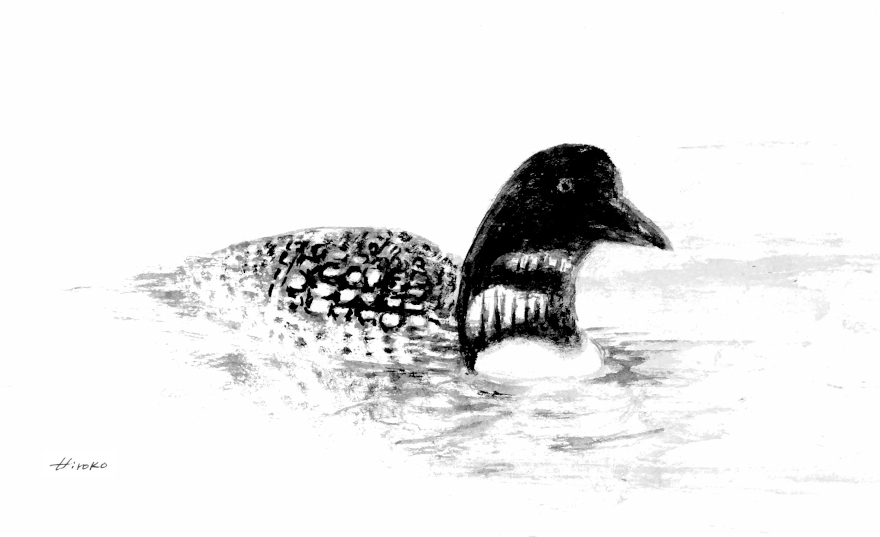
Common Loon – Gavia immer (excerpt)
Voice: The Common Loon has a haunting, 3 part wail.
Habitat: Common Loons prefer large, clear lakes and coastal habitats where they can catch small fish by sight. Because they are so heavy, they need long stretches of open water to take off for flight. Their legs, placed far back on their bodies cause them to swim exceptionally well but walk awkwardly.
Psalm of the Loon
Did you hear him calling along the blue morning?
His throat filled with sorrow on the lake?
Tears falling from carnelian eyes?
Did you see the thrash, a froth of waves,
before he dove, in search of her still?

He arches his neck, lifts his dark head.
a sip of deep water in his sharp black beak.
His wings open. He calls, the sound
shimmers in the air, leaves a residue.
Regret. A vast grief that mutes him.
He lifts off as shadow, as a relic mist.
Do you see sparks on the water? Reflected
sunlight? Candles lit for a mass of the dead?
Can you see her, unmoving, just below?

~ Pamela Moore Dionne
Pamela Moore Dionne is a frequent birder and a Port Townsend, WA poet/writer/visual artist. She is the author of two chapbooks, and can be found at www.pamelamooredionne.com.
Dr. Stephanie Delaney (Bird Notes) has been birding seriously since the pandemic, submitting birds most days in eBird, with over 1500 reports submitted to date. She is especially interested in urban birding and teaching more diverse audiences the joys of the bird world.
Hiroko Seki (Artist) is a Nihonga and Sumi-e artist: “I enshrine moments from nature. Nature draws in my senses. Sumi-ink, soy, and dye drive innovation in my Sumi-e.”
Susan Rich (Editor) is the author of six collections of poetry and co-editor of two prose anthologies, and a recipient of the PEN USA Award and the Times Literary Supplement Award (London). She lives and writes in West Seattle.