
By Andy Valencia
Bake It

Reality TV has been with us for almost 35 years. Networks loved it because people – for free – would line up to behave shamelessly for the cameras. Viewers loved it because, well, really I have no idea. But it contributed to decades of an entertainment wasteland.
Every cloud has its silver lining, and my family has become fans of a particular type of reality TV. It started with The Great British Bake Off (“GBBO”), a show with amateur bakers attempting various baking challenges (plaited bread, pancakes, cakes, mirror glazes …) while being judged by a pair of top bakers in the industry. As you watch the tribulations and triumphs of each season’s bakers, you learn about whole new kinds of foods. Even with something as familiar as bread, you will learn so many details of the baker’s art that you can’t help but try baking your own loaf.
Our first loaf was great! Beginner’s luck. The next one was a collapsed misery. If you’re like us, a few internet searches plus something you saw on the GBBO will get your third try back on track. Along the way, you’ll pick up all sorts of useful tips — one of my favorites is that if you need to eat dense or dried out bread, run water on both sides and then toast it.
Then you might try sourdough, or you get some of that spelt flour and try an alternative to wheat. Pretty soon, you’ll have a rotation of fresh breads, with weeks and then months going by without having to purchase their commercial counterpart. Home-baked loaves here tend to cost us around $2, so there’s a boost to the shopping budget as well.
Sew It
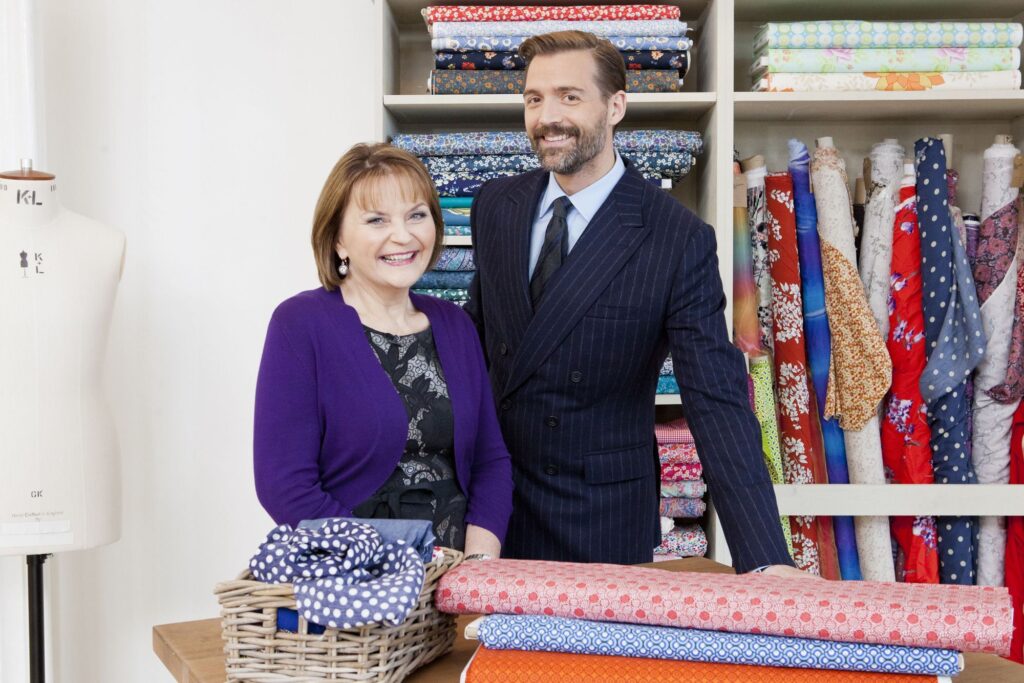
We didn’t know it, but we had caught “the bug.” Not the home baking bug, something bigger. Because we next encountered The Great British Sewing Bee. As in the Bake Off, there are amateur sewers and famous judges, including no less than a Savile Row tailor. As with the Bake Off, your view of the world changes as you learn about the details of clothing. You begin to notice how a dress hangs, or the tidiness of its pleats.
You may never sew your own tuxedo, but once you know how sleeves are inserted into the body of a garment, you might break out your little sewing kit and fix a seam that is starting to open. If the old threads are in the way, you’ll have already seen the unpicking tool (basically, a sewer’s “undo” button) in action. Even when you have to hit the web for some extra details, having seen so many amateur sewers work with many materials and techniques will give you the vocabulary to search for details efficiently.
Once is happenstance. Twice is coincidence. Three times is enemy action. A famous war quote from Ian Fleming, but it sort of applies to my family.
Throw It
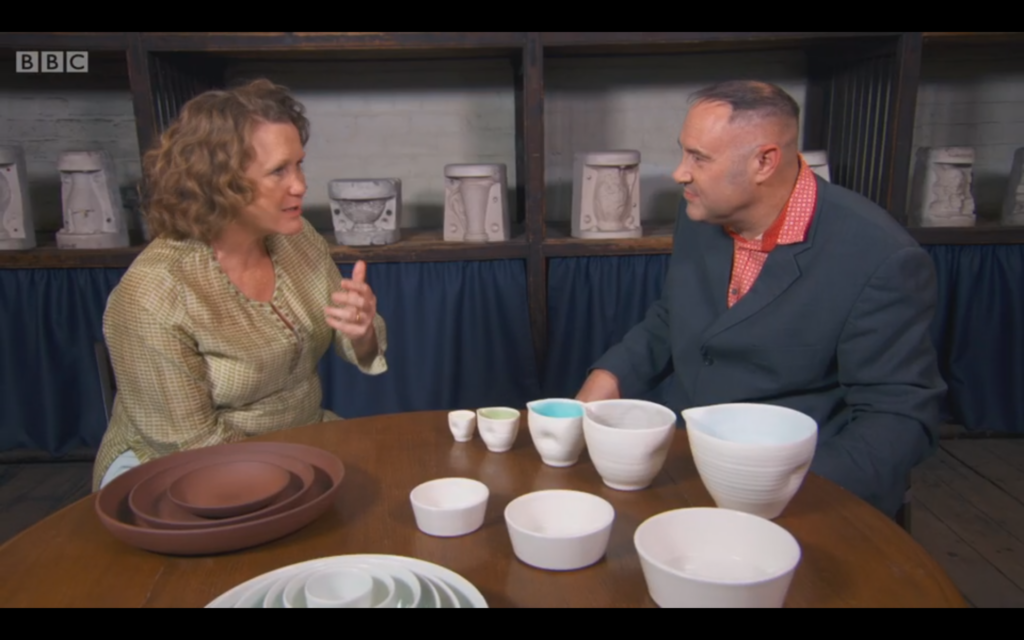
Most people are aware of pottery, and have probably seen somebody forming clay on a spinning pottery wheel, a skill known as “throwing.” But what’s the difference between a dish and a plate? How does a kettle gets its spout – or its handle? How does throwing 3 pounds of clay differ from 6 or 9 pounds?
The format is familiar by now – two expert judges and a gaggle of amateur potters. And yet, bakers are nothing like sewers, and neither is anything like a potter. All three groups use muscle memory, an artistic sense, and years of acquired experience with their materials. Heating to 350 degrees turns batter into a cake; heating to 1,000 degrees or more turns a clay piece into its ceramic counterpart.
That temperature is no joke; just a bit of trapped moisture will cause the piece to explode in the kiln. Thus, potters usually spend a great deal of time trimming away any unneeded clay thickness. Kiln temperatures give you that hard, smooth surface of a plate. But the piece can be painted with a glaze, its post-kiln color having no relation to its pre-kiln appearance. Stray glaze on the bottom of the piece will cause it to stick to the kiln shelf, another source of shattered pieces — even the most experienced potters admit they’re never sure exactly what will come out of the kiln.
You’re Not (Just) a Consumer
Like any other reality TV show, you can certainly sit back and watch somebody else live their life, Truman Show-style. But I hope you’ll consider the possibility that you can make or mend a shirt, bake your own batch of cookies, or possibly even make a pitcher or flower pot. We’re surrounded by a world that calls us “consumers;” why not start being defined by what you produce, instead?
You’re not on your own. Just do a search for “baking class on Vashon,” or the same kind of search for “sewing” or “pottery.” Aruba Clay Studios is run by a family friend, with regular pottery workshops. And, of course, Kavi Rana has written about sewing right here in The Loop. Hey, expert bakers, sewers, potters of Vashon – send The Loop a note if you offer classes!
What might come next? I’m hoping for welding, or maybe plumbing.
