
By Anthony Latora
As the seasons change and the leaves begin to fall, I start to notice the daylight growing shorter and the cold beginning to return. A shift in myself begins to occur – from the highly expressive, movement-filled nature of summer toward the harvesting, tending, and inwardness of fall. The fruits are ripe now, ready to give themselves to those who know how to enjoy them. Among the many plants announcing the arrival of autumn, one tree in particular catches my eye: hawthorn.
There is an old folklore surrounding hawthorn, particularly in the British Isles, where certain trees were associated with fairies and other beings of the unseen world. Hawthorn trees were sometimes regarded as trees of the threshold, and disturbing or cutting certain ancient specimens was traditionally approached with caution.
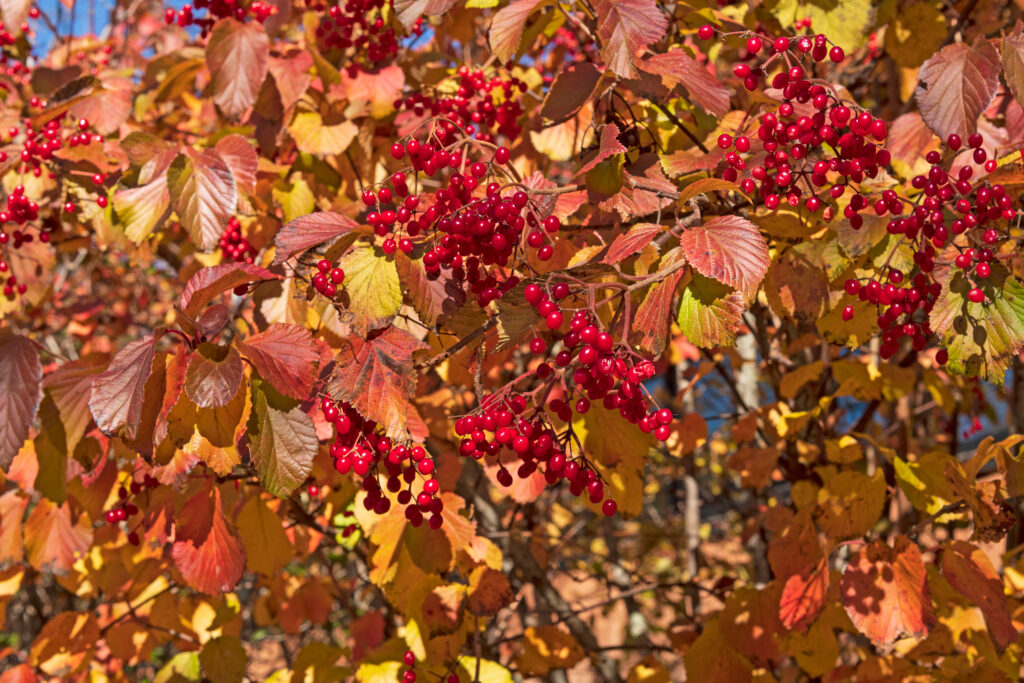
Hawthorn has a long history of relationship with people, both here in the Pacific Northwest and across the landscapes of Europe. One of our native species is black hawthorn, Crataegus douglasii. The leaves are deciduous and somewhat leathery, with an oval shape that can appear broader toward the tip. In spring, the tree produces clusters of small white flowers with five petals and numerous stamens. By early fall, these become small, apple-like fruits that mature from red toward a deep reddish-purple or nearly black color. The bark ranges from reddish-brown to gray-brown, and the branches may carry formidable thorns, sometimes approaching an inch in length.
Other hawthorns can be distinguished by different growth habits and leaf shapes. Some introduced species are more distinctly tree-like, while others form dense thickets. European species such as Crataegus monogyna are commonly cultivated and have also become naturalized in parts of the Pacific Northwest. C. monogyna generally has deeply lobed leaves, showy creamy-white flowers, scarlet fruits, and usually a single seed within the fruit. Other European hawthorns, including plants historically referred to as Crataegus oxyacantha, may have two or more seeds.
Identification can become complicated quickly because hawthorns are notorious for hybridizing. Native and introduced species may cross, producing plants that don’t always fit neatly into a single field-guide description. This is one reason I find hawthorn such an interesting plant to learn in the field. The more closely you look, the less nature seems interested in fitting itself into our categories.
Here in the Pacific Northwest, native black hawthorn is commonly encountered in moist, open habitats, particularly around wetlands, streams, rivers, and moist canyons. Introduced European hawthorns are frequently encountered in more human-influenced landscapes, including urban environments, roadsides, fields, hedgerows, and valleys west of the Cascades. When identifying hawthorn, pay attention to the whole plant rather than relying on a single characteristic: the leaves, growth habit, flowers, fruit, thorns, bark, habitat, and number of seeds all become pieces of the puzzle.
Hawthorn contains a diverse collection of constituents, including flavonoids, oligomeric procyanidins, rutin, triterpenoids, and various other compounds throughout the plant. The cardiovascular activity of hawthorn is particularly interesting because it cannot simply be attributed to one isolated constituent. Different preparations contain different proportions of compounds depending upon the species, plant part, growing conditions, harvest timing, and preparation method.
This is one of the reasons consistency matters so much in herbal medicine. Rather than searching for one molecule responsible for everything the plant does, the herbalist can pay attention to the entire process – from the species and growing conditions to the part harvested and the method used to extract it. Standardizing our growing, harvesting, drying, and preparation practices gives us greater consistency while still respecting the complexity of the whole plant.
The flowers and leaves are generally gathered in spring when the plant is actively flowering. When working with fresh-flowering branches, the leaves, flowers, and young twigs can be incorporated into a fresh preparation. If working with dried material, the leaves and flowers are typically separated from the woody portions before preparation.
The berries arrive later in the year, generally becoming ready for harvest in early fall as they fully ripen. This timing varies by species and location, so the tree itself is the best guide. The fresh berries can be tinctured while still plump and vibrant, or they can be dried for later use. Fresh berries contain considerable moisture and can ferment if improperly handled, so they should be processed promptly after harvesting. Hawthorn berries have a tart, tangy, sour, and slightly sweet flavor with an astringent quality that leaves the mouth feeling gently tightened.
Hawthorn is traditionally regarded as a cardiac nutritive and cardiovascular tonic, particularly for supporting the healthy function of the heart and circulatory system. In traditional Western herbalism, hawthorn is often described as a slow and gentle cardiovascular tonic rather than a dramatic stimulant. Its relationship with the heart is one of the reasons hawthorn has earned such an important place in the herbal materia medica. From an energetic perspective, hawthorn is traditionally associated with states of excitation, atrophy, and relaxation, particularly where the tissues require cooling, nourishment, tonification, or gentle regulation.
This makes sense when considering the plant’s relationship with the heart.The heart is constantly moving, constantly working, and yet it must also remain responsive and adaptable. Hawthorn seems to occupy a similar place within the materia medica: nourishing without being overly stimulating and regulating without simply suppressing activity.
Hawthorn has also been traditionally used for digestive discomfort, nervous tension, and states of restlessness or irritability. Its cooling and astringent qualities can make it useful in preparations intended for red, irritated, or inflamed tissues. Externally, preparations of the leaves and berries have traditionally been used as poultices for minor skin concerns and to help soothe areas affected by small splinters or thorns.
The cardiovascular actions of hawthorn are an area of considerable herbal and pharmacological interest, but this is also where a responsible herbalist needs to recognize the limits of the plant. Hawthorn should not be treated as a replacement for medical evaluation of serious or unexplained cardiac symptoms. Persistent chest discomfort, fainting, significant shortness of breath, or unusual or persistent changes in heart rhythm deserve appropriate medical attention.
Hawthorn’s reputation as a heart tonic does not mean that every heart condition is an appropriate situation for self-treatment. This is particularly important because hawthorn can interact with cardiovascular medications. Anyone taking medication for the heart or blood pressure should discuss its use with an appropriately qualified healthcare professional.
One of the simplest traditional preparations is an infusion of the flowers and leaves or a preparation made from the berries. For a traditional cup of hawthorn tea, the dried plant material can be steeped in hot water for approximately 20–30 minutes. The berries can also be prepared separately, although their dense texture means they may benefit from a longer extraction.
Tincturing is another excellent way of preserving hawthorn. Fresh berries can be tinctured soon after harvest, while dried berries, leaves, and flowers can also be prepared separately or in appropriate combinations. For a more concentrated preparation, a decoction may be used for the berries, although prolonged aggressive boiling is not necessary. Gentle heat and sufficient extraction time are usually preferable to violently cooking the plant.
There is something about hawthorn that I find especially appropriate for autumn. The tree gives generously. It gives flowers in spring, fruit in fall, nourishment to wildlife, and a long history of relationship with human beings. Yet woven through all of this generosity are thorns. Hawthorn reminds me that nourishment and boundaries do not have to be opposites. The fruit is sweet enough to invite us closer, but the thorns demand that we pay attention.
Perhaps that is part of what makes hawthorn such a fitting plant for the changing season. Summer encourages us outward – toward movement, expression, growth, and abundance. Hawthorn stands at the threshold of autumn, asking us to pause with its darkening fruit and thorn-covered branches, offering its medicine while reminding us to approach with respect. And as the light continues to shorten, perhaps that is exactly the medicine many of us need to remember.
