
By Emilia Flor
Autumn is the season when the Pacific Northwest begins putting itself away for winter.
We can feel the change before we usually see it. Mornings are colder. Light comes lower through the trees. Rain taps against cedar branches and darkens the bark. Wet leaves soften beneath your boots, and the air takes on the unmistakable scent of damp earth, moss, and decaying wood.
The birds notice, too.
A Steller’s Jay lands in a hazelnut tree, its blue feathers startling against the muted greens, yellows, and browns of the forest. It pauses, head cocked, listening. It picks up one nut, rejects it, and tries another.
The bird isn’t merely feeding. It is making decisions about the future.
Summer residents are heading south while winter visitors arrive from the Arctic tundra and boreal forests. The birds that remain adjust their diets and routines. Some turn toward berries, seeds, and nuts. Others search beneath bark and through leaf litter for the insects and spiders that remain. Waterfowl, shorebirds, and raptors gather wherever the changing season concentrates food.
The landscape is changing, and the birds are reading it.
The Wisdom of the Cache
Birds teach us preservation.
They don’t simply gather food; they make choices about what is worth carrying forward. A sound nut is worth the effort of carrying. A damaged or insect-eaten one is not, particularly in a climate where persistent moisture can quickly turn stored food into spoiled food.
The black-capped chickadee takes a different approach. Small, quick, and seemingly tireless, it carries individual seeds away and hides them in countless places throughout its territory. A seed disappears into bark, beneath lichen, or into another carefully chosen hiding place. Then the chickadee is off again.
Birds teach us diversification.
If one cache is lost, others remain. Their food supply is scattered across the landscape rather than concentrated in one place. Our pantry may be a refrigerator, cellar, or shelf of jars; the bird’s pantry is the forest itself.
And then there is quality control.
Every nut or seed represents an investment of effort. What a bird chooses matters. We understand this instinct, too. We sort the harvest, save the best, and preserve what is sound enough to last.
And some of what the birds hide will never be found again. Forgotten seeds may germinate in spring, becoming part of the next generation of forest.
The harvest continues beyond the harvester.
The Landscape as Pantry
By mid-autumn, I find myself thinking about the pantry differently.
The birds have been gathering for weeks. The forest floor is giving up its mushrooms. Deer are feeding on autumn mast. And when the tide pulls back, oysters wait in the cold water along the estuaries.
The pantry isn’t really a pantry at all.
It’s the entire landscape.
Walk through the forest after rain and the senses become part of the harvest. Water beads on sword ferns. Moss glows against dark bark. Somewhere in the canopy, a red-breasted nuthatch gives its nasal, tin-horn call. Beneath it all, the forest smells of cedar, mushrooms, and wet soil.
Chanterelles emerge among moss and fallen leaves, their golden color startling against the damp forest floor. Deer move quietly through the same woods; sometimes there is only the soft crack of a branch, the rustle of fern, and then silence.
Beyond the forest, the air changes. Wet earth gives way to salt. The tide recedes, exposing mudflats and tidal beds where shorebirds work the shoreline and gulls, crows, and eagles search for what the water has uncovered.
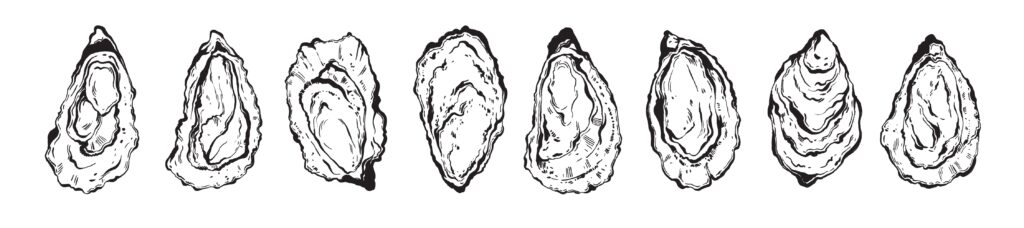
Oysters and Dungeness crab become part of this coastal harvest – sweet, briny, and deeply connected to the cold Pacific waters.
Forest.
Forest floor.
Coast.
Humans and birds are responding to the same autumn landscape.
We simply bring the harvest home differently.
Venison brings the richness of the forest. Chanterelles bring the damp, earthy character of the forest floor. Oysters bring the briny sweetness of the tide.
The canopy has led us down to the forest floor and outward to the tidal waters.
Now all three landscapes come together in one pot.
PNW “Forest & Coast” Venison and Oyster Stew
Historically, combining wild game with shellfish (like venison and oysters) was a staple of coastal indigenous communities and early PNW settlers. The briny depth of the oysters acts as a natural flavor enhancer, cutting through the lean, earthy richness of the venison.
Ingredients
- The Forest (Proteins & Veg): 1 lb venison stew meat (cut into 1-inch cubes); 1 cup wild chanterelle or cremini mushrooms (sliced); 2 strips of thick-cut bacon (diced); 1 small yellow onion (chopped, medium cut); 2 carrots (medium diced, about ¼-½ inch); and 2 sprigs of fresh rosemary and thyme.
- The Coast (Liquids & Finish): 1 pint fresh PNW extra-small oysters (with their liquor/juice); 2 tbsp butter; 2 tbsp flour; 2 cups beef or game stock; ½ cup heavy cream or whole milk; salt and cracked black pepper to taste.
Directions
- Sear the Forest Bounty: In a heavy Dutch oven, crisp the diced bacon over medium heat. Remove the bacon, leave the fat, and sear the venison cubes until deeply browned on all sides. Remove the venison and set aside.
- Sauté the Foraged Goods: Toss the mushrooms, onions, and carrots into the same pot. Sauté for 5-7 minutes until the mushrooms release their moisture and brown slightly, absorbing the rich fats.
- Build the Gravy: Stir in the butter and flour, cooking for 2 minutes to form a roux. Slowly whisk in the stock and the reserved oyster liquor (juice), scraping up the flavorful browned bits from the bottom of the pot.
- Simmer: Return the venison and bacon to the pot along with the fresh herbs. Cover and simmer on low for about 1 to 1.5 hours, until the venison is melt-in-your-mouth tender.
- The Coastal Finish: Turn the heat down to a bare simmer. Stir in the heavy cream. Gently fold in the raw oysters. Cook for just 3 to 4 minutes until the edges of the oysters begin to curl. Season generously with cracked black pepper and serve with crusty sourdough bread.
Rooted: A Women’s Circle for Whole-Life Wellbeing
Join facilitator Emilia for a welcoming women’s talking circle exploring holistic health – body, nature, food, purpose and connection – through Dr. Zach Bush’s 8-Point Journey of Intrinsic Health.
Check out the link below:
Rooted: A Women’s Circle for Whole-Life Wellbeing with Emilia Vogt – Women Hold the Key.
