
By Emilia Flor
Wendell Berry died at the end of August at the age of 92, and his passing was felt across the many worlds he spent his life contributing to: agriculture, conservation, poetry, literature, and the humanities. In all of them, his work returned to one relationship: the bond between people and the land that sustains them.
He was a farmer, poet, novelist and essayist, and he spent most of his life on a farm near Port Royal, Kentucky, in the country his family had worked for generations. He asked us to consider our place in relation to the land that connects us to the soil, the water, the farmers, and the food on our plates, including our place in agriculture. What we tend to shapes what grows.
His novels and stories return again and again to Port William, an imagined Kentucky town much like the one he knew, where the lives of people and the land they work are woven together. He wrote his poems by hand, often outdoors or while walking his fields, and he found that good writing and good farming call for the same discipline: patience, humility, and a willingness to let nature keep its own pace.
His Mad Farmer poems give us a stubborn, joyful farmer who laughs at the chase for quick profit and loves his neighbors and his ground. In “The Peace of Wild Things,” one of his most cherished poems, he speaks to the worry anyone feels about the world their children will inherit. His answer is to go to the water and sit among creatures who live without fear of tomorrow, and there he finds rest.
In his essay “The Pleasures of Eating,” he called eating an agricultural act. Eating is a daily participation in the life of the earth, and he believed the true pleasure of eating grows from knowing where our food came from.
The soil sat at the center of his thinking. He saw it as the great connector of lives, the source and the destination of all of them, and he taught that without care for it, we have no life. He also saw an economy that sells the earth’s harvest while wearing down the earth’s ability to produce. When we choose cheap, heavily sprayed, monocultured food, we vote for eroded topsoil and poisoned local water, and we live at the expense of our grandchildren. Every time we eat, we cast a vote for the world we leave behind.
Berry saw the land and the people who live on it as one shared life. When the land is stripped, the community that depends on it is stripped too, as strip mining has done in his home state. When a farm is run like a factory, the farmer becomes one more part of the machine. Soil security is human security, and when we wound the land, we wound ourselves. In “The Unsettling of America,” he described two kinds of people: those who take from a place and move on, and those who stay and care for it. He spent his life among the second kind, and he asked us to take a humble posture and to admit how completely we depend on nature.
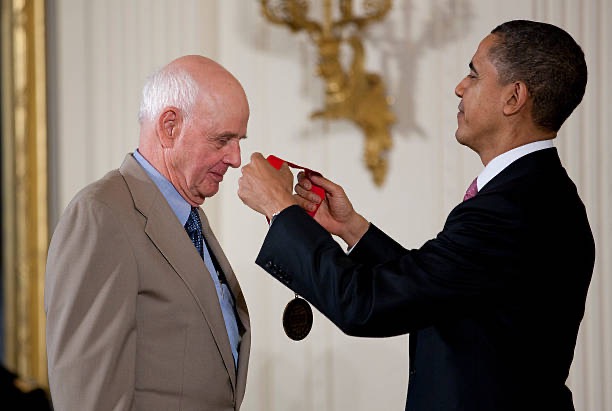
The world took notice. He taught for years at the University of Kentucky, received the National Humanities Medal in 2010, and gave the Jefferson Lecture in 2012. Through all of it, he kept coming home to the same farm. Here on our Island in the Puget Sound, Berry’s life reminds us of what we are already caretaking: the land under our feet, the water that surrounds us, and the people who share this place. His way of paying attention is one we can carry on, one season at a time.
Wendell Berry leaves behind a shelf of books, a farm and a way of paying attention. We are grateful for his life, and for the soil and clean water that his writing helped so many people honor for the generations still to come.
There will be a “Remembering Wendell Berry” event on November 22nd on the Island. For more information please contact via email, tmorgan@cmonbarber.com.”
