
By Stephen Buller
The initiative to reject Washington’s “millionaire’s” tax was shot down in spectacular fashion, and it looks like high-income Washingtonians will be filing a state income tax return starting in 2028. If you think it won’t affect you in any way, I hope this article will give some perspective on how taxes usually work, as well as a critique on this specific tax.
When the Revenue Act of 1913 was passed, 358,000 federal income tax returns were filed, representing roughly 0.8% of the population. The tax rate was 1% on people earning over $3,000 (~$80,000 adjusted for inflation), going as high as 6% for people earning over $500K (~$13 million adjusted for inflation). The main purpose of the tax was to lower tariffs on imports to reduce costs on basic necessities for the average American.
The Washington income tax will theoretically be paid by 25,000 households, roughly 0.8% of the population. The tax rate is 9.9% on all income over $1 million. The stated purpose is to fund education, healthcare, housing, and human services – though attempts to earmark funds for specific use have been rejected so far.
Today, single individuals earning under $16,000 aren’t required to file a federal income tax return, 70% of households pay some federal income tax, and the top 50% of earners pay 97% of the tax. I expect the state income tax will move in the same direction – on a shorter timeline.
The main reasons the tax will affect more people over time, in order of impact in my opinion, are 1. government incompetence, 2. inflation, and 3. capital flight.
First, have you noticed taxes only seem to go in one direction? Government only seems to get larger, propose more programs, and spend more of our money? I think this is natural, as every entity has a self-preservation incentive, and doing more for constituents, hiring more people, and commanding more tax revenue brings security for a governmental entity.
Second, even though wages haven’t kept up with inflation, they do rise over time. As the average wage goes up, it is unlikely the state will increase the standard deduction (in fact, they will try to decrease it), so more people will be liable for the tax in the future.
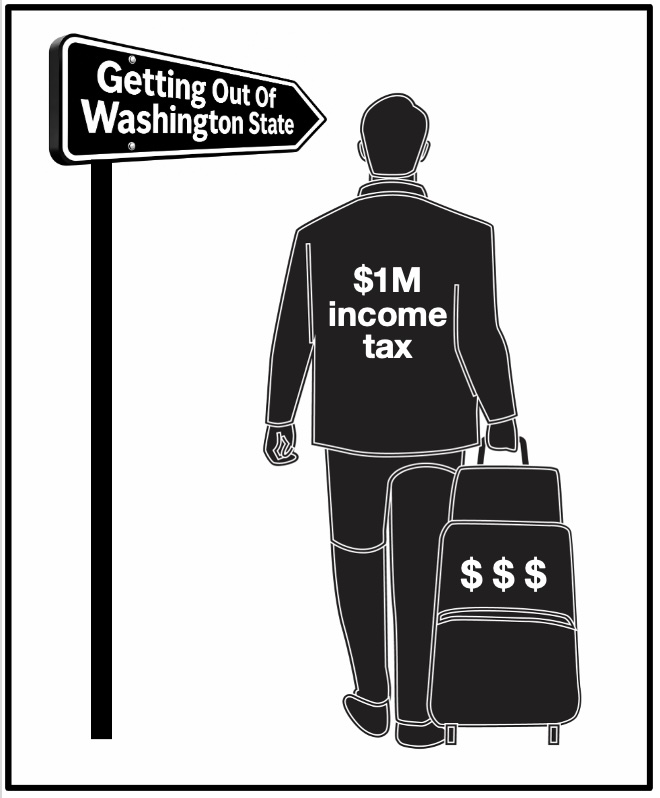
Third, as higher earners are taxed in Washington, some will relocate to avoid the tax. These higher earners are usually the ones with the means to physically move or intelligently arrange their income-generating assets to avoid taxes.
The first issue is a natural, unavoidable incentive, in my opinion. The second is mostly at the feet of the federal government and their choice to allow a private banking entity, The Fed, to counterfeit our currency into oblivion. The third is the one I’m most concerned about.
Capital flight might seem like a small or unlikely issue, but we have already seen it from Jeff Bezos, Howard Schultz, and others. Furthermore, it’s not only the loss of that tax base (and the need to then assess taxes on lower earners), but the loss of highly skilled individuals that will hurt our prospects for a prosperous future in Washington.
Herein lies my main issue with this tax: It seems as though successful individuals are being blamed for government failures. Most millionaires made their money through hard work and innovation, creating products and services people voluntarily paid for in the free market. They added great value to society and were rewarded for it.
Our governments at every level, on the other hand, have repeatedly delivered overpriced and ineffective services. Washington’s education budget has increased from $18 billion in 2000 to $42 billion today, outpacing inflation, while serving roughly the same number of students, with many classes and programs cut.
Healthcare is effectively free for many, but the ballooning true costs are one of the reasons the state is desperate for tax revenue. Washington spent $5 billion on housing and homelessness programs since 2013, and the issue is worse than ever.
The affordability challenges facing all of us are not lost on me. The idea that those with greater income should pay more in taxes is reasonable. But the assumption that more taxes will solve our problems is based on the false premise that government can solve our problems. And the conclusion that we will be better off if we take more money from productive members of society and give it to the government is terribly misguided.
Our government has used our shared plight to turn us against our innovators, builders, and job-creators, blaming financially successful people for poor policy, bloated government, and reckless spending.
If this “millionaires’” tax was replacing our sales tax, I might sing a different tune. Instead, we are all going to pay more in the long run – as wages rise, the standard deduction falls, and skilled individuals flee. What will we receive for our tax dollars? Greater dependence on an inefficient, ineffective economic model that will bring all of our standards of living down.
I think the real solution is in the opposite direction – smaller government, more freedom, and of course, sound money.
