By Jane Valencia
A few months ago, in a conversation between herbalist and frequent Loop writer, Kathy Abascal, and co-editor Caitlin Rothermel and myself, we spoke about the ability of plants to work on the entire spectrum of our health from the physical, psycho-emotional, to the spiritual. We speculated: if herbs can address dis-ease on many levels of our being, might they possibly help on a community level? If so, what herb might we suggest for our Island community, and how might one apply this remedy?
We observed that many Islanders feel severe stress and anguish in response to current events and politics. A sense of despair, anger, fear, and doom pervades our zeitgeist. Any herbal help for this state?
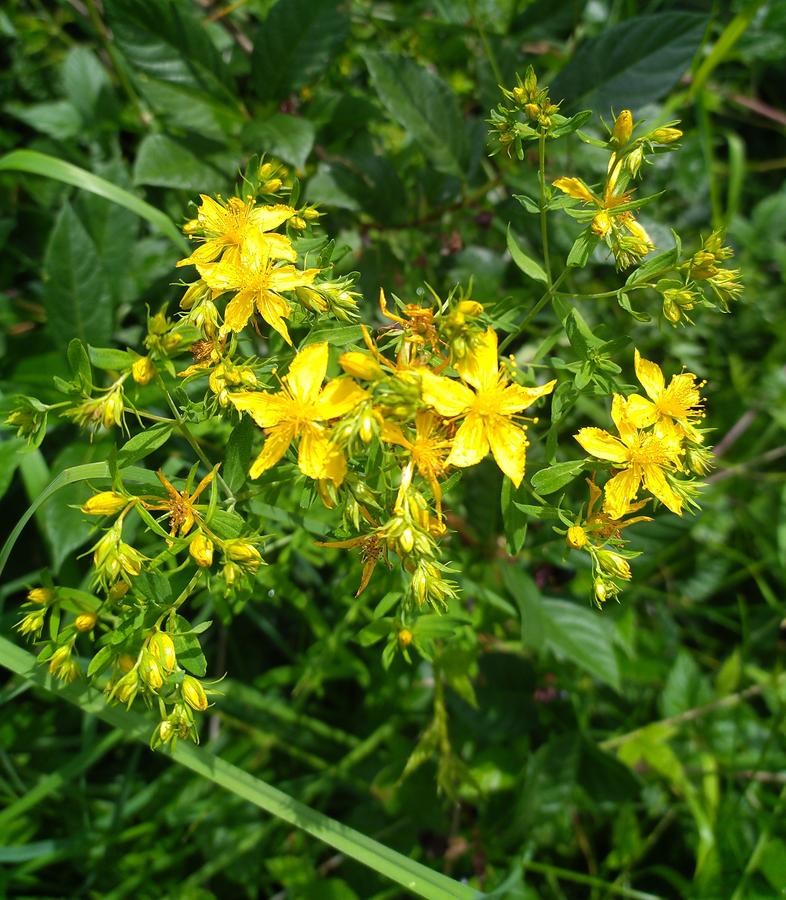
One plant that came to mind is a sunny herb in bloom now and through the rest of summer, and found in fields and field edges, roadsides, and in wet meadows: Hypericum perforatum, more commonly known as St. John’s Wort. Named for St. John the Baptist, whose Nativity Feast day is June 24, this plant is sometimes referred to as St. Joan’s Wort or Solsticewort. Note that any species of Hypericum that stains your fingers red-purple when you crush the buds or flowers has medicinal properties and can be used accordingly. However, the large-flowered, ornamental St John’s Wort planted in garden beds is not used for remedies.
Like St. John the Baptist, the medicinal plant generally has a rangy and ragged appearance. It proclaims “good news” in the form of numerous flowers – golden stars made up of five sun-hued petals each – on opposite branched stems. The paired oval leaves contain “perforations” – tiny pinhole-like translucent glands. These glands – and the darker ones near the leaf edges – produce some of the constituents like hypericin and the hyperforin that make up the herb’s potency.
The flowers are 3/4” or so wide, and the plant grows 1” to 3” in height. The flowering tops, bud, flower, and leaf are used in teas, tinctures, or are infused in oil, and have a slightly bitter, pungent, sweet taste.
Medicinally, St. John’s Wort is wound-healing, calms inflammation, relaxes and nourishes the nervous system, tightens tissues, is a liver-cleanser, repairs damaged nerve cells, and more. The herb is well known for treating certain kinds of depression, cold sores, herpes, and other viruses, alleviating nerve pain, and stimulating and improving liver function.
The physical actions of an herb often affect the psyche and spirit in corresponding ways. For example, in cleansing the liver of toxins, St. John’s Wort can cleanse harmful emotions.
Herbalist Michael Moore suggested St. John’s Wort for those who have a good, happy life, with some struggles they are able to meet, until they hit a bump. Then they find it difficult to cope.
This description might indeed apply to many of us in response to the larger events of recent years, from COVID to now.
Since our conversation, I have continued to ponder St. John’s Wort for community healing.
Michael Moore wrote, “I think of using Hypericum [St. John’s Wort] when someone whose circumstances have changed is unable to alter his ways of acting and responding. Such people follow the previously reliable responses and strategies, but their life needs new approaches: they are stuck in a rut, spinning their wheels, and feeling growing frustration and depression with their problems. Hypericum … is for normal folks whose strategies have failed and are temporarily adrift.”
On a community level, the “bump” mentioned previously is more like choppy waters in a once smooth and predictable sea. On a grand scale, decisions and events outside of our experience and control are in play, and collectively, we find ourselves in emotional upheaval. As we check in with our digital media of choice, yet another event, decision, or speech by a public figure contrary to our perspective punctures our psyche like a needle. Our sense that the world is dangerous and doomed amplifies with each attempt to stay informed and do something. Oppression and intensity builds with every outrage we hear or read.
I’m reminded that St. John’s Wort has a long folk use for spiritual protection against demons, witches, being snatched by the fairies, and against the evil eye. Our modern times are entwined in their own “spell work” – harmful forces and speech under new guises. An endless onset of bad news, along with manipulative strategies in various spheres serve to heighten volatile emotions and a sense of helplessness. We leave behind ideals of loving one another and seeking and cultivating peace within ourselves and with others. And we fall further into social patterns in which we demonize as an outlet for our pain and anxiety (cancel culture is an example).
Our minds are captured, our hearts hijacked, and the intense darkness grows.
How might a simple, summertime herb possibly make a difference in such a landscape?
Let’s return to just ourselves and the plant.
Herbalist Kiva Rosethorn writes that St. John’s Wort “drives away sadness and unwanted melancholy, calms obsessive anxiety, feelings of vulnerability and unsafeness, emotional hypersensitivity, and a sense of doom that refuses to lift.”
And again: “When life has shoved you down, turned off the lights, and made you feel alone and afraid and like you’ll never find the light again, this is a good time to turn to Hypericum. Tea, tincture, flower essence, even a small pouch of the plant hung around your neck or carried in a pocket.”
Herbalist Matthew Wood notes: “Remedies which act on the solar plexus are often psychological in their influence because they improve the gut level instincts, and this helps people deal with unconscious phenomena in their lives.”
How might we work with St. John’s Wort as an Island community? Each of us is different, and herbalism understands that there is no one-size-fits-all remedy. Some of us might want to work with the plant medicinally, in which case one should research this herb (see the resources at the end of this article) or consult with an herbalist or naturopath in order to figure out the form, dosage, and strategy that is right for you. Taking medicinal doses of St. John’s Wort can interfere with the intended actions of pharmaceuticals.
One can also work with St. John’s Wort in ways that offer balm, insight, and other qualities that may lighten the spirit and encourage a calm strength and joyful disposition in our hearts. Consider seeking out the plant to sit with in nature and appreciate, and as a focus for meditation or reflection. If the plant is away from roads and in a toxin-free area, you might taste a leaf or a flower. Be sure you correctly identify the plant before doing so, and observe plant safety basics (see my August 2023 article on vashonloop.com). With thanks to the plant, you might break off a sprig to keep with you.
We have heard that “peace begins with me.” In many ways, these dark days are a deception, firing us up or weighing us down, and isolating us from one another. Allow St. John’s Wort to shine a light for you, helping you reground and reroot, even – or especially – in soil that may now seem inhospitable. This summertime herb reminds us that generosity resides along every wayside – within our Island nature and community, and in the larger world, and that we are meant to serve as medicine for one another. In our rebalance, we, like a rangy plant can make a difference in the life and health of what matters to us.
Resources:
Medicinal Herbs of the Pacific Northwest – Michael Moore, www.swsbm.com
Calm: Portraits of Weedy & Garden Relaxant Nervines + Differentials – Kiva Rosethorn, enchantersgreen.com
St. John’s Wort: Herb of the Week – Katja Swift, commonwealthherbs.com
The Book of Herbal Wisdom – Matthew Wood, matthewwoodinstituteofherbalism.com
St. John’s Wort Health Benefits – Rosalee de la Foret, www.herbalremediesadvice.org