
By Marc J. Elzenbeck
In a previous installment, we looked at the Toyota RAV-4 in its early forms, a handy-sized workhorse renowned for its durability and steady character. But among the many things a 20-plus year old RAV-4 has never been known to say are, “Hey, wanna see how fast we can make it down this wet mountain road?”
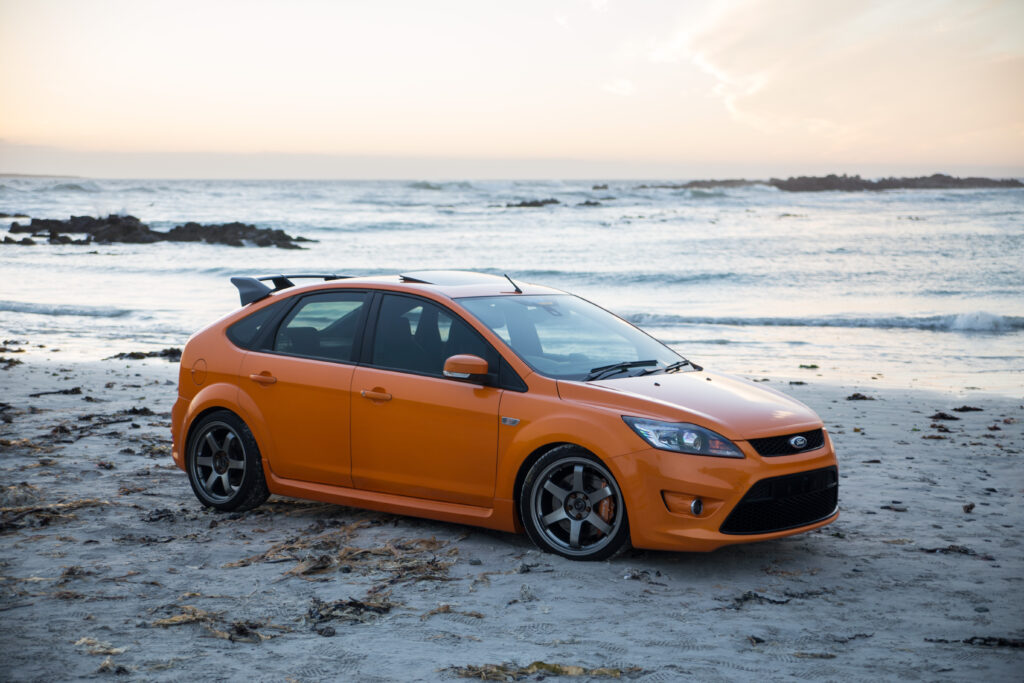
That is a question you might get from a Ford Focus, a high scorer on both fun and economy, and in most versions, reliability. To stay with the horse theme, the Focus would be a Morgan: frisky and agile, smaller than average but surprisingly strong. Easy on the eyes with a touch of refinement. On these merits, the base model first-generation Focus won the Car and Driver Ten Best award in its compact class from 2000-2004, then for the US-specific second-gen and turbo ST versions in 2012 and 2013.
Ford sold tons of them. Over 12 million were made before being recently discontinued, nearing 3.5 million in the US. Manual transmission models commonly go over 300,000 miles, and you can sometimes pick up local examples with only 150K on them for a few thousand bucks. Like the RAV4, there are a few documented examples that have refused to die, reaching 900,000 miles and above. There’s a red 2007 hatchback on Craigslist in Olympia right now for $2,800. Manual transmission, very good condition, no dents, 157,000 miles. It beckons to me, probably at the expense of domestic harmony.
Now, the Focus acquired a bad reputation when Ford replaced its proven old automatics with marginally more fuel-efficient dual-clutch PowerShift DPS6 autos in 2012. Made by Getrag, these proceeded to often shudder and emit weird noises and smells on their way to early, grinding deaths. Ford claimed this was perfectly normal, but eventually lost two class action lawsuits and was forced to direct its dealerships to fix (and usually replace) them. Following this blunder, they removed the car from the North American market in 2019, citing unprofitability. That’s where the opportunity is – nothing says “bargain” like discontinuing a model after transmission failures.
The MTX-75 5-speed manual transmission has been praised as “bulletproof,” one of the best ever made. When paired with the standard Focus 2.0-liter Duratec engine, developed in partnership with Mazda, you get a great combination of performance and longevity. About 40% of first-gens and 12% of second-gens had manuals. These can be hard to find, but even if not available or preferred, it’s likely a surviving PowerShift auto model has been fixed.
Also, there is a cottage industry of gearheads who remove a broken auto transmission and replace it with an MTX-75 manual. For an outlay of about $1000 for parts plus their labor, they can flip a defunct but low-mileage example into a several thousand-dollar sale. With only about $5k, you can get a car with 200,000 miles of upside.
What kind of upside? The car was designed for Europe by British and German engineers, which means it had to face brutal competition in the small sports sedan arena. It was a runaway success, becoming a favorite among young buyers and families. The steering is precise and quick, the handling is flawless and almost neutral for a front-wheel drive, it’s so comfortable and quiet you hardly think about it. Mileage is great and storage is as good as anything in its class. Yet it was also widely successful in European road racing, with strong advantages in relatively cheap high-performance parts and easy upgrades.
In Germany a decade or so back, I rented a second-gen for a month. Despite having a little 1.0 liter engine, the thing would sustain 190 km/h (118 mph) on the Autobahn. It likewise excelled in city driving. Coming back from the spectacular Cro-Magnon paintings at Chauvet Cave in southern France, there was an opportunity to climb through the rugged, sparsely trafficked alps of the Massif Central. Where it was easy to see why the Focus has won so many World Rally Championships.
This is neither a confession nor recommendation to break international or local speed limits, or to make your traveling companion retch with carsickness. But hypothetically, equipped with that engine, you could definitely average 43.6 miles per gallon over a month of doing so.
The Focus is a rare vehicle, one that makes it all look easy. So easy it sort of disappears in the US market, where it was never properly marketed by Ford. Hyundai and Kia noticed, however, and each made almost identical-looking knock-offs which have become top sellers. Look closely and you will notice quite a number of young men driving presentable or modified Focuses, having already priced the hotter-engined ST and RS versions out of reach.
If you earn your own money and are starting out, most of the common Focus problem areas (upper engine mount wear, radiator overflow cracks, various sensors and fuses) are easily self-fixed at modest expense. And these can be gradually budget-upgraded to performance levels approaching or exceeding the hotter versions.
For our purposes, on our Island, the Focus fits right in. Any mechanic knows how to work on them, domestic parts and spares are plentiful and cheap. They are inherently ditch-avoidant, structurally sound, and good-to-excellent in mud and snow. Notes of caution are that getting an inspection before purchase is always a good idea, particularly for those post-2012 dual-clutch auto transmissions, and dealers have been scooping them at auctions and up-charging double what they paid.
While it won’t win a beauty pageant, rumors are making the rounds that we’re soon going to get an on-Island car wash. A Ford Focus cleans up real good.
(For in-depth info and pro maintenance tips, check out Big Ben’s Cars and Cycles on YouTube.)
