
A Health Matter
By Caitlin Rothermel
If humming came in a pill, you would probably consider taking it.
One of humming’s most measured effects is on the nervous system. Even a single session of humming promotes parasympathetic activity, also known as the “rest and digest” state. This is the body’s natural recovery mode, where the heart slows, stress decreases, and internal resources are redirected towards healing, processing, and repair.
Vibrations from humming also directly affect the sinus cavities around the nose, creating pressure waves that literally “ventilate” this normally poorly ventilated area. Think of it as gently pumping fresh air through tiny chambers where air movement is usually limited. This dramatically increases the release of nitric oxide (NO), a molecule produced in especially high concentrations in the sinuses. NO plays a major role in keeping blood vessels healthy and in the body’s natural defenses against bacteria, viruses, and fungi.
This NO finding led to an intriguing question – could repeatedly ventilating the sinuses while bathing them in NO, achieved by humming, help relieve chronic sinusitis? One researcher tested this approach on himself, practicing deep humming for one hour at bedtime followed by 60 to 120 hums four times a day. He reported that his month-long chronic sinus symptoms improved dramatically within four days.
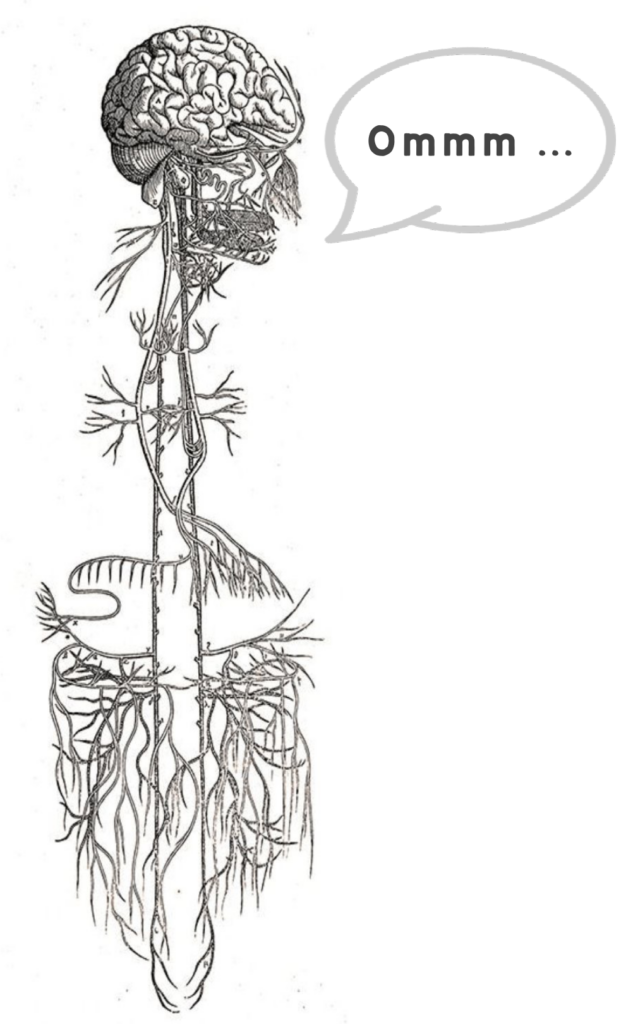
The quality of humming that is most helpful is the kind of deep hum that vibrates your nasal passages and is built on short, repeated phrases. A number of traditional vocal practices have these characteristics, including Buddhist, Hindu, Gregorian, and many Native American chants, as well as the deep “Ommmm …” that many of us have voiced at least once.
All these forms of humming trigger the same basic physiologic pattern: prolonged exhalation, slow rhythmic breathing, and sustained vocal vibration. Together, these features help stimulate the vagus nerve, one of the body’s primary communication pathways between the brain and major organs.
Named after a Latin word that means “wandering,” the vagus nerve starts in the brainstem, just behind the back of the throat. As it descends through the neck into the chest and abdomen, it divides again and again, sending branches to the heart, lungs, stomach, intestines, and other organs. Spread out across the lower body, those branches almost resemble the kind of apron you would tie around your waist.
Reading this description, you might expect that the vagus works in a top-down, “brain-to-bottom” manner, but that would be incorrect. Most of its signaling (about 80%) is conducted from the bottom-up (from the “apron” area back to the brain). The vagus primarily acts as a sensory information highway to inform the brain about the body’s internal state.
Only about 20% of the vagus nerve’s activity involves carrying commands from the brain to the body. That’s where humming comes in. Branches of the vagus directly control the vocal cords (or folds, as they are now more often called), parts of the throat and larynx, and the muscles involved in swallowing. When you hum, the brain sends signals downward through these branches to produce the sound. At the same time, the humming alters breathing, vibration, and the body’s internal state, generating new sensory signals that travel back to the brain along the vagus.
In this sense, humming creates a self-sustaining conversation between the brain and body.
One of the clearest ways scientists observe this conversation is through its effect on the heart. The vagus nerve slows heart rate and helps regulate the timing between heartbeats. As humming encourages slow, rhythmic breathing and strengthens vagal activity, it also tends to increase heart rate variability (HRV), the subtle variation in time between heartbeats that reflects the nervous system’s ability to adapt to changing demands.
Higher HRV is generally associated with greater resilience and a healthier balance between the body’s stress and recovery systems. In one study, humming improved several measures of HRV and reduced the physiological stress index more than sleep.
I know what some of you are thinking: “Humming is fine, but I’m more of a singer.” Good news – singing appears to engage many of the same bodily pathways, although it has not been studied in as much depth. Like humming, singing naturally encourages slower, deeper breathing, and prolonged exhalation.
One fascinating study found that, when choir members sang together, their breathing and heart rhythms gradually synchronized.
Science doesn’t often make headlines for explaining ordinary things. But sometimes it reminds us that the habits we’ve had for centuries were quietly doing something useful all along.
Here’s a link to a short video, “5-Minute Humming Practice for Anxiety Relief” that can get you started; there are lots of other useful videos that are easy to find: www.youtube.com/watch?v=P7qSclakd3A
