
By Andy Valencia
Have you or a loved one had to give up on bread? Many people find that modern grains are too hard to digest, but when sourdough meets historical grains, a new option might help. Amri Valencia shares her experiences making sourdough bread using a grain which has enjoyed recent popularity.
Einkorn is an ancient grain, possibly the first wheat ever used by humans. It has even been found in the stomach of a 5,300-year-old corpse which had been laying, frozen, in the Italian Alps. What worked for an early forebear might work for you, too.
Set aside your factory yeast, because this sort of bread works with the wild variety that you can capture right out of the air. Although the goal is an einkorn loaf, rye has proven to be an excellent basis for the sourdough starter, which provides the yeast function. Like einkorn itself, rye seems to help avoid wheat sensitivities.
Do note, however, that both einkorn and rye still have gluten. Those with gluten sensitivities should keep this in mind.
To start your personal sourdough, use an open bowl, covered with a cloth, holding ¼ cup of rye flour mixed with enough filtered water to give it a liquid consistency like batter – just thick enough to stick to a spoon. Stir it a few times each day for a few days, and it will presently start to have a slightly sour smell (sourdough!) and a few bubbles, after which you now add one more cup of rye flour, along with the water needed to get back to that batter-like consistency.
Once it again has a distinctly sour smell and looks bubbly, you can start using it. Generally, the bowl you used to start it is needlessly large; at this point, most people move the starter into a mason jar.
As you use the starter, add more flour and water to replace the lost amount. Typically this will be a ratio of ⅔ cup rye flour, ⅓ cup of filtered water. The chlorine present in most water systems is not yeast-friendly, so be sure to filter it out.
On days when you don’t use your sourdough, discard about half, then replenish using the ⅔ – ⅓ ratio to keep it fed. Yes, it’s sad to send the sourdough away uneaten! But your compost bin will love it.
If you won’t be baking for a while, you can slow down the sourdough’s lifecycle by refrigerating it. When in doubt about how it’s doing, give it a sniff. A hungry sourdough culture smells harsh, a bit like nail polish remover. If this happens, discard half, and replace that half with the usual flour-water mix. Give it time, and it will usually bounce back.
It’s time to make your first einkorn loaf. Scoop some of your starter out, and replace it in your starter jar with the flour-water mix. You’ll want ¼ to ½ cup of starter, mixed with 4 cups of whole-grain einkorn flour, 1 cup of filtered water, and if the dough is too tough, add additional water a bit at a time.
You’re not shooting for a kneadable bread dough, just something that’s not so thick you can’t stir it with a spoon. No sugar is needed, but add a tablespoon of oil (usually olive) and a teaspoon of salt. Remember – no yeast. That’s the sourdough starter’s job.
Stir to uniformity, then let it sit about 8 hours as it rises. Stir it once or twice along the way, to make sure the starter culture spreads evenly. Most of the rising will happen late in the process, so after the last stir, let it rise to loaf size. It will take as long as it takes – perhaps 4 more hours. If you used ¼ cup of starter for your first loaf, try ½ next time to see if you like the results better. You and your personal sourdough will get to know each other.
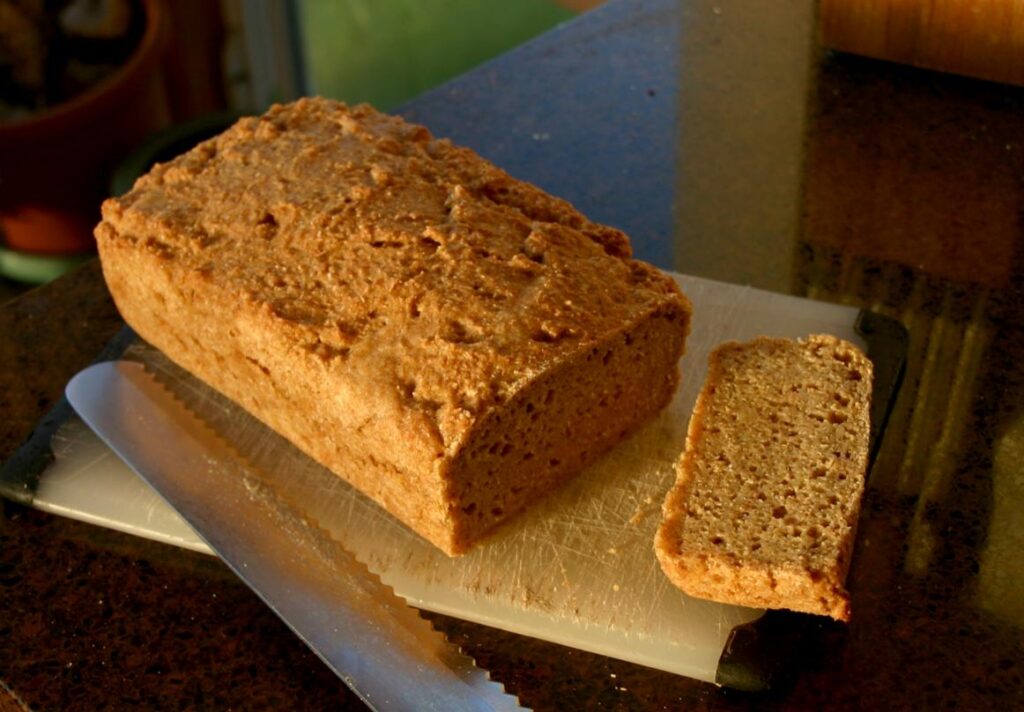
Grease a bread pan (we use lard), pour in the dough, and place in a preheated 350° oven. Baking time will be about 70 minutes for this size of loaf. It won’t really brown, so you mostly go by timing. If you make a bigger loaf, you’ll have to use trial and error to find out how much extra time is needed. Be warned that whole-grain sourdough loaves don’t bake as quickly as their white-flour cousins.
When underbaked, your loaf will be gummy inside; something that’s true of whole grains even moreso than white flour. Make a note and give it some extra time when you try again. Whole-grain sourdough tends to be quite hard to overbake in a 350° oven, which makes the process of experimentation a forgiving one.
You can experiment with mixing herbs and cheese into the dough, but the flavor of sourdough loaves tends to dominate anyway. Another ancient grain worth trying is kamut, which you can use much like einkorn, but we find it takes a bit more water to reach consistency, and otherwise bakes just like einkorn.
