
By Richard Odell
Some among us get trees like a disease. Big boys are especially prone, but big girls get it too, sometimes. The psychosis might simmer for years, before it really starts to roil.
I’d always been a plant guy, and I liked trees well enough. Wanted to see more of them, hated to see less. But around the age of forty, I was completely taken in by them, in all their countless forms. And like many a fool before me, I sought to make a livelihood of them.
Sometime before this fevered delusion took over, I fended off my mother’s suggestion I grow Christmas trees in the field surrounding her Island home, where I shared residence off and on since returning from California. I saw the glut coming, and thus the one and only smart business decision in my life would be to simply avoid the business altogether.
It didn’t last. With multiple layers of irony, I would later plow ahead, planting saplings, seedlings, and cuttings on once fallow ground. I scoured roadsides and commercial landscapes for seeds and cuttings. I took biweekly trips, with camera, paper bags, and scissors to the Arboretum in Seattle (Sorry, folks, statute of limitations, and all that). I stuffed a refrigerator with sandwich baggies bearing seeds and moist sand. I gathered containers. I had big plans.
As to those layers of irony: The field surrounding my family home, where now I sought to enculture decorative trees, was a remnant of what had once been someone’s fifteen acres of currants, and before that, fifteen acres of cherry trees. I know the mentality: “I’ll get it right, this time,” we tell ourselves. As to the rest, it was now given over to alders, Himalayan blackberry, and a handful of houses.
The homebuilders were something of a mystery to me. I had grown from infancy to maturity in but one house, and had returned to that same house in my thirties. I would have been happy to stay there. These others, they’d build a house, live there a few years, then sell and move on. Subsequent owners displayed the same curious restlessness. The broken fields of my youth were now the greenswards of perennial strangers.
The nearest of these new estates, built by known locals who once lived below us along Cunliffe Rd., was at this time on its third set of residents since the builder quit the scene – to build another house, somewhere – just a few years before. This latest couple (always it was a couple, and always childless), in their early forties, maybe, had a professional aura. Briefcases. Late-model Mercedes. Never home much, as far as I could tell.
They stayed nameless to me – which was fine by me – until one late spring afternoon, the woman hailed me from across our shared, but undefined, border, as I dug away at the encroaching turf around some birch saplings.
I joined Lois – turns out her name was Lois – near the backside of our shed, satisfied her inquiry as to the property line, as I imagined it, added a few pointless, random factoids about the history of our properties, and then, perhaps in response to my revealing the nature of my work, she invited me on what proved a rather perfunctory tour of her garden. It was brief and to the point, involving a narrow border along one side of the house, plugged rather thinly with new, mail-order bedding plants, some of which arrived – I’m fairly certain – already in bloom.
There wasn’t much for either of us to say. She made no pretense of being a gardener, and there was little on display on which I could think to append my own two bits of insight. This seemed, in tone, her overarching attempt at being neighborly, and my own passive acquiescence to the charade. Our total lack of contact resumed unabated, with little notable change in their habits, or mine, other than the rather curious disappearance of the Mercedes, and the equally curious clamour of saws and hammers, out of sight, that arose for a brief spell in the fall.
Then one gray afternoon, some weeks after Christmas, Lois’s voice again broke over my shoulder as I was hacking away at the relentless sod. I turned, and was caught up short by the sight of her in a wheelchair.
I spread my hands in inquiry as I approached her. I was informed: she had contracted an aggressive form of multiple sclerosis, and, subsequent to that, her husband had left the scene. She offered no details on her husband’s decampment, and I didn’t delve, but I’ve seen it a number of times: the one spouse leaves the other when the chronic affliction sets in.
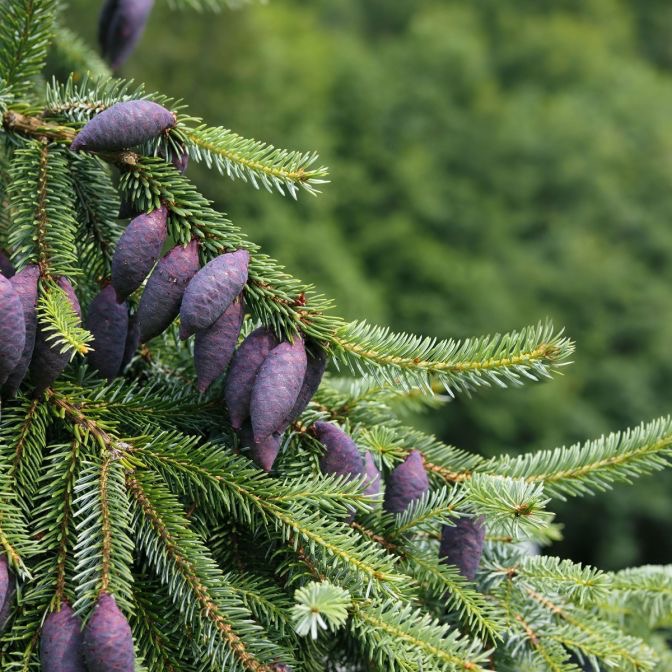
She asked if I might help her plant a tree, something for which I seemed a likely candidate. It was a young Serbian spruce, if I remember right, a fine choice for the landscape as it is for a living Christmas Tree, which indeed it was. I might have thought it strange, that in the chill echoes of a hollowed out domestic life, she had hoisted the festive arbor, but maybe not so.
Anyway, we planted the spruce where we thought best, jointly admired it a long moment, and then she invited me in for tea. I’m a coffee drinker, but okay. Following her, as she wheeled up the gangplank which was her newly built ramp, and entering through the kitchen, I thought I knew what to expect further in, having been on sociable terms with the homebuilder: Modern Scandinavian. Clean, straight lines of bare wood. But, oh, far from it, now.
The living room entire was draped, hung, festooned, and layered over with autumn leaves. In sandwich and quart-sized plastic baggies, pressed autumn leaves of every sort. Reds and golds everywhere, on walls and tabletops and chairs. She knew the names of some. She queried me for the rest. I did the best I could.
The samples went far beyond the native ranks. She asked of various trees she’d seen about the Island. In one case, unable to verbally describe the specimen, she did a wonderful impersonation, with stretched arms and torso, of a cottonwood tree.
I think I drank two cups of tea.
There’d be more trees between us as the year went round, those urged upon her by friends, along with one more living Christmas tree. It was our only point of contact–a failure on my part, to be sure. And one February afternoon, with me there, knocking the dirt from my boots while she regarded a newly situated Japanese Maple, she simply remarked, “That makes me happy.” We let it go at that.
I never got to say goodbye. Family came when I wasn’t looking, and scurried Lois away to California. Thirty years and seven rental houses later, without a sapling to my name, I’ve half a mind to get lost one of these days, wind up in her old driveway, apologize to whoever’s about for the unintended intrusion, and regard the growth of her happiness, before I back away.
