
Marc J. Elzenbeck
It’s always sunny in San Diego. Even on November 26th, 2025, the start of Thanksgiving weekend, it was still great for driving convertibles. Hugo Parra and Ariel Beltran decided to make that afternoon even better. They hopped into Ariel’s red Alfa Romeo and drove from their apartment complex over to the Churchill Cigar Lounge in Old Town. Possibly they relaxed awhile before both were arrested.
About five miles away, a patrol cruiser had responded to a 911 call of an attempted carjacking. Drawing up to the scene, officers observed a suspect speeding away in a red Alfa Romeo, which they called in to their headquarters dispatch desk. Far across town, a camera time-stamped Beltran’s car 23 seconds later. Staff soon searched San Diego’s new Flock Safety database for hits on a “red Alfa Romeo.” They sent backup to Old Town to find and arrest its occupants, presumed armed and dangerous.
Hugo and Ariel seem likely to get a fair amount of money from the city of San Diego for roughly interrupting their cigars, even after dropping the cases against them. Hugo couldn’t afford to pay his bail and stayed in jail until December. Their lawyer’s name is Alex Coolman and they’re suing for false arrest, unreasonable detention, negligence, failure to perform follow-up investigations, and damages to reputation. Their apartment complex had its own surveillance cameras, which proved they were nowhere near the crime.
San Diego was more interested in using its powerful Flock Safety software tools. Images were allegedly unable to provide a positive match on the Alfa Romeo’s license plate, but did return a lock on its model and color. That is not surprising, but interesting. It means the company, a startup financed by venture capital firm Andreessen Horwitz, has built a vehicle recognition model from previously collected data continuously gleaned by its nationwide network. Like recognizing speech or faces, but funner. It is now advanced enough to identify a fairly rare vehicle – perhaps about 5,000 old red Alfa Romeo convertibles are still rolling around the U.S.
False arrest stories are popping up everywhere. A mom in Milwaukee, Wisconsin was arrested because her vehicle was red-flagged and not properly removed from the camera’s database watchlist, and she claims a resulting job loss. Robert Dillon of Fort Myers, Florida, is suing the city of Jacksonville Beach for using an incorrect facial recognition result to falsely arrest him on charges of luring a minor. He was 300 miles away. Nationally, law enforcement officers of every rank are being sued and fired for using automated systems to check up on spouses, love interests, or to track and harass exes and personal enemies. “Digital stalking” is becoming a legal term of art.
These cameras and their software are effective, with impressive recognition accuracy, but they still make very expensive mistakes. They are not merely Automatic License Plate Readers (ALPRs.) They are often combined with full-spectrum, networked, always-on radio-frequency harvest devices. These read every passing vehicle’s Bluetooth. Cell phones. Screens. Tire pressure monitors. Radio-frequency identification devices; if you or your dog are micro-chipped, they read that.
Flock’s public relations department has claimed that all municipal police records are deleted after 30 days; facing waves of backlash, they recently reduced that deletion claim to a suggested 7 days. But in the ways we commonly use and understand words, these are not correct assertions.
As it happens, I have collected and analyzed large amounts of digitized data. I’ve written data collection contracts and negotiated for and against technology companies and partners. I don’t think of myself as an “expert” in this field because no one in AI truly knows what they’re doing. It’s a work in progress, akin to how scientists nicknamed the first atomic bomb “The Gadget.”
What I do know is you don’t un-collect valuable data, and if you’re building, say, a proprietary new vehicle recognition model or need to decode a license plate from an acute angle in poor light, you’ll save every last kilobyte. Because you can’t know exactly what you’re looking for in advance. So I got Flock’s contract with the City of Houston and sat down with it over a coffee.
Flock collects everything they want. My impression from their contract is they intend to guard their collected data forever, like a dragon lying atop a mound of treasure in a deep, dark cave. Much as I would do. The contract’s wording indicates they can time-limit local departments from accessing records stored locally or on the company’s servers; it states checking a past record is possible, but expressly not guaranteed, and requires a court order. As one clause points out, federal agencies and third parties are not necessarily so constrained. None of which sounds like “delete.”
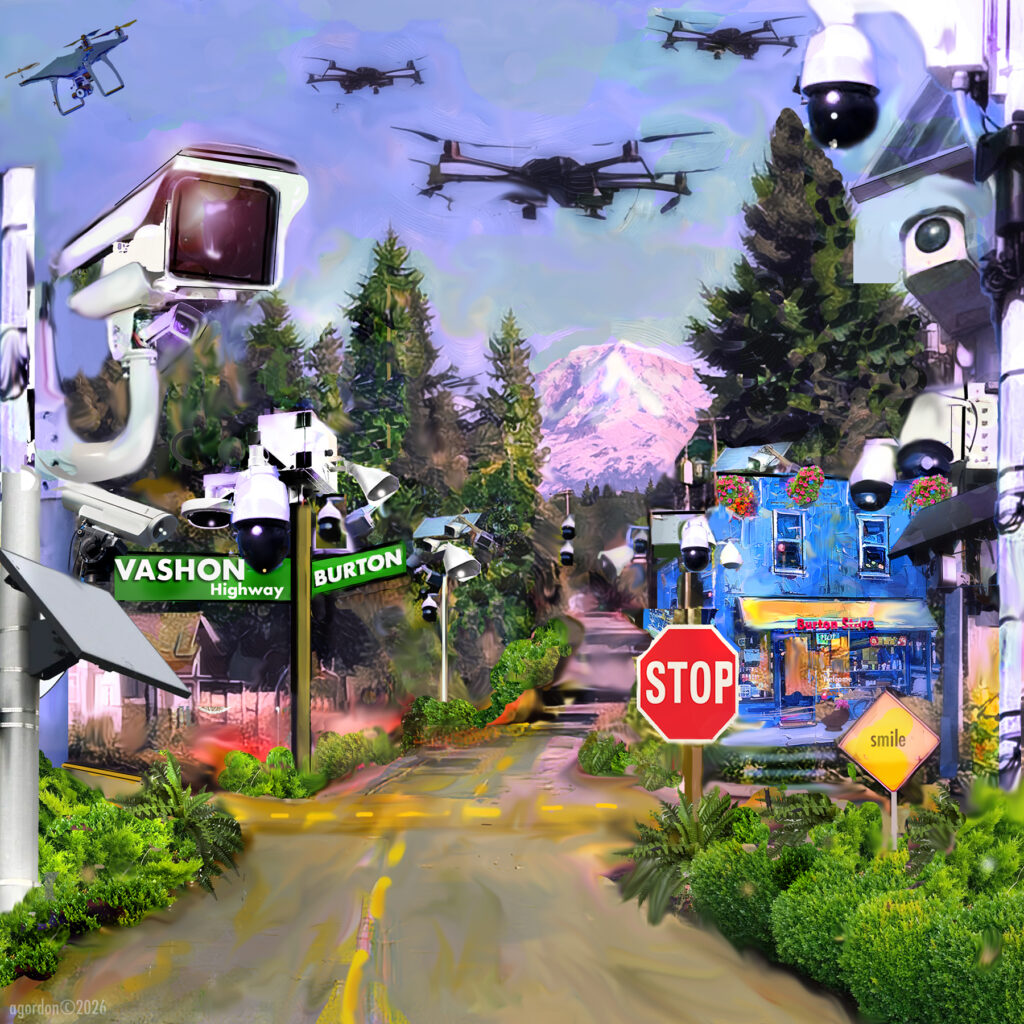
At last count, there are about 2,200 Flock cameras in Washington State. None yet on Vashon, but cameras are everywhere, including on most of our easily trackable cell phones. In its wisdom, Flock has acquired a drone company called Aerodome (another Andreessen startup) for $300 million. The idea is to hover drones at an altitude of 400 feet above roads, to remotely provide real-time law enforcement info and feed 360-degree optical data into Flock’s networks.
This class of drones is capable of zooming in on a subject’s face from over a mile away with thermal imaging for night or day detection. These could be dispatched to scenes in advance, leveraging police time. Hard to imagine a locale better suited for that technology than Vashon.
In Winona, Wisconsin, unknown vandals cut down all the Flock installations. Their police chief recently stated they wouldn’t be replaced, as the citizens obviously do not want them. In Union Township, Ohio, a suburb of Cincinnati-Dayton, a man named Cody Morelock cut a Flock installation off at the base, then destroyed it where it fell. Prosecutors brought a charge of felony vandalism against him, good for six months to one year in jail.
A grand jury convened last month, dismissing the case against Mr. Morelock. The name caught my ear: in H.G. Wells’ 1895 novella The Time Machine, the Morlocks were a race of burly subterranean monsters who would emerge to snatch the surface-dwelling Eloi. The far-future relationship between the Morlocks and the Eloi was complex and confusing, but symbiotic. As it turned out, it was the Morlocks who raised, cared for, and sometimes ate the Eloi.
Hopefully, ongoing push-back and developing sensible safeguards for similar digital surveillance tools won’t have to go quite that far.
