By Richard Odell
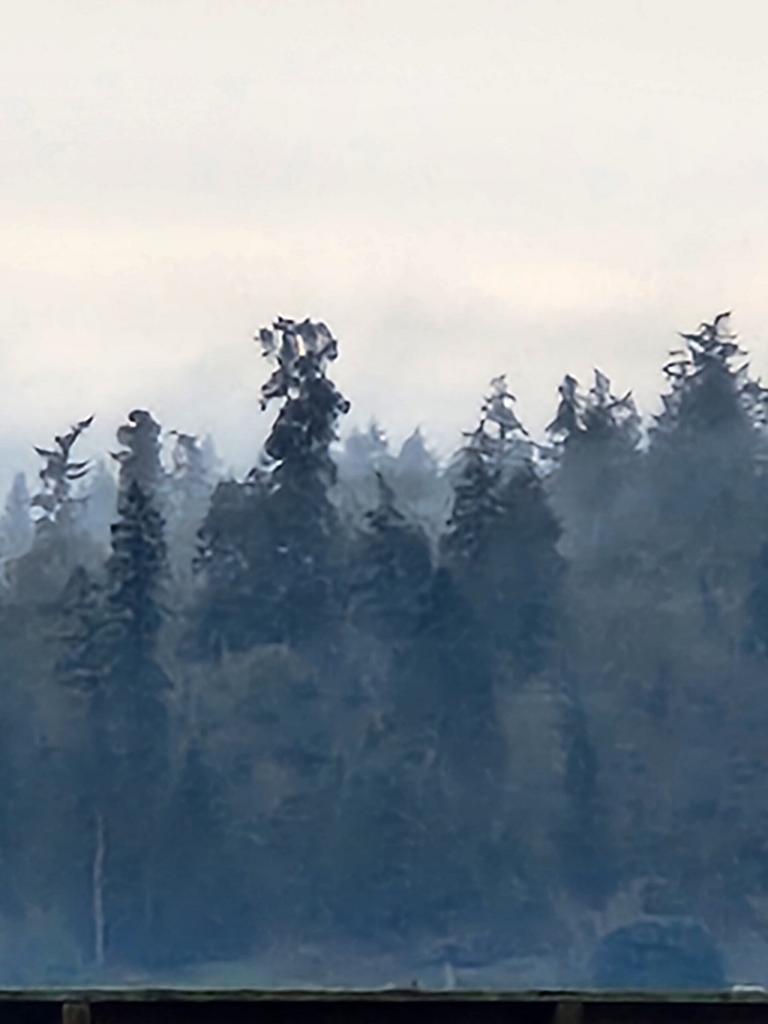
We know them mostly by their strange profile, if we know them at all, rising singly, here and there, above the dense skylines of Douglas Firs, their rounded, shaggy heads in contrast to the pointed spires of their surrounding neighbors. They are the rare and “true” firs, Abies grandis, of Vashon-Maury.
A word, first, about arboreal nomenclature, or what my botanist friend at the old Beall Greenhouses called, with spoken capitalization, “The Fallacy of Common Names.” The Douglas Firs cannot be true firs, so it’s said, because they are not of the genus Abies, which had previously been given the title. The Western Red Cedar and the Alaskan Yellow Cedar cannot be called “true” cedars because they are not of the genus Cedrus, like the storied cedars of Lebanon.
The primary distinction, of course, is in the flowers and cones. “You know a tree by the fruit it bears.” Coincidentally, both Abies and Cedrus produce upright cones which shatter while on the branch. Rarely are they found complete on the ground. The pendulous Doug Fir cones, as we know so well, fall complete in form, and gather everywhere in abundance. Abies needles lay flat and smooth, as opposed to the angled needles of Doug Fir, and smell like grapefruit when crushed. The trunk of Abies grandis is gray, with shallow grooves, much like our western hemlock (Tsuga heterophylla) .
As to the illegitimacy of the Doug Firs (Pseudotsuga menzieii – alas, even their scientific name paints them as phonies, or “false Hemlocks”), the taxonomist would likely prefer the game be played by Latin rules, as the word, fir, from Middle English, derives from the old Scandinavian, and was originally appended to the Norse word for oaks, meaning, presumably, evergreen oaks – not to be confused, one supposes, with their true oaks, or, in our day, with the live, or “true” evergreen oaks of North America.
Credit the Doug Firs their adaptability. They occupy varied climes and situations. The Grand Firs of Vashon-Maury cling to only a handful of sheltered enclaves, all at low elevation (a trait shared with our equally rare and true Ash trees, Fraxinus latifolia). We find them on the eastern side of the Burton Peninsula, aside Dockton Park and along the straight stretch of Dockton Road, in one section of the western slope of Maury, in the crook of the harbor along Quartermaster Drive, and in one slightly elevated spot at the North End. Likely a few others are tucked away, here and there.
Look across the water to the low-lying end of Blake Island, and one might spot several more suspects, popping up above the usual mess of Pseudotsuga .
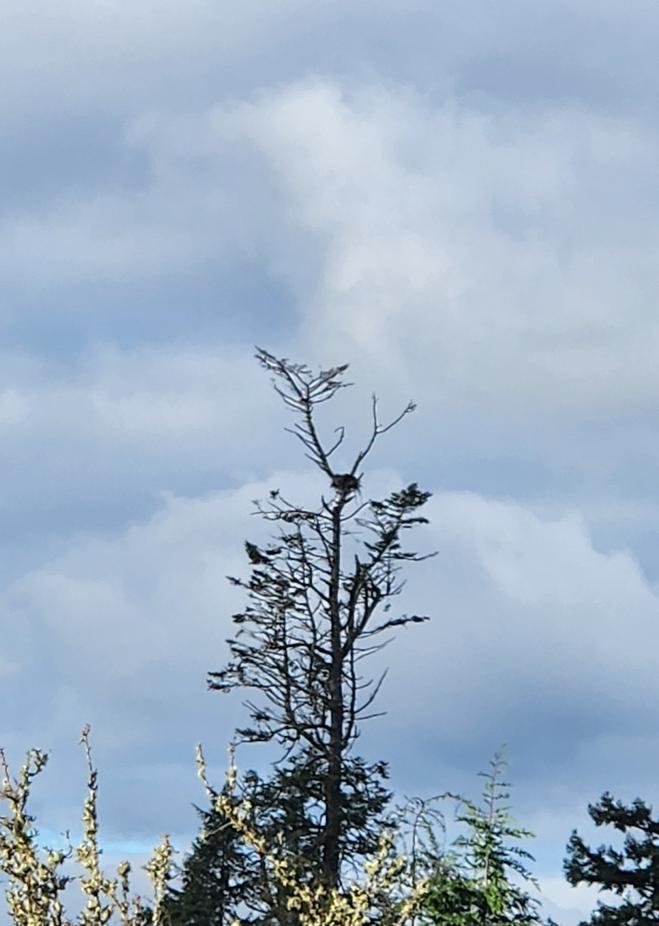
We spy our Grand Firs, mostly, at a distance. They are not great breeders, and do not crowd upon us, though a few healthy, young specimens might be found scattered broadly about the elders, especially along the Burton Loop, where they appear most at home. Interestingly, landscaped Abies along the high point of Maury do not seem particularly happy, but the species does tend to raggedness in maturity. The Grand Fir profile is derived by how they alter, in maturity, the manner of their lead growth. When a mature Doug Fir loses its leader, it will attempt, rather awkwardly, to replace it with the tortured turning of a single branch. Mature, true firs, in response to breakage, or even by nature, will spring forth with many fingers of upright growth; a final, crowning effect which may oft prove useful, as these high, multiple branches may in time become the site of an eagle’s nest. Two such aeries can be viewed on Maury.
Were the true firs ever abundant here, and, if so, will they yet again prosper? What with their lack of fecundity and space, one might wonder, though they may yet be supplemented from our various abandoned Christmas Tree plantations. But that’s a story – and a rant – for another day.
Captions: