
By Caitlin Rothermel
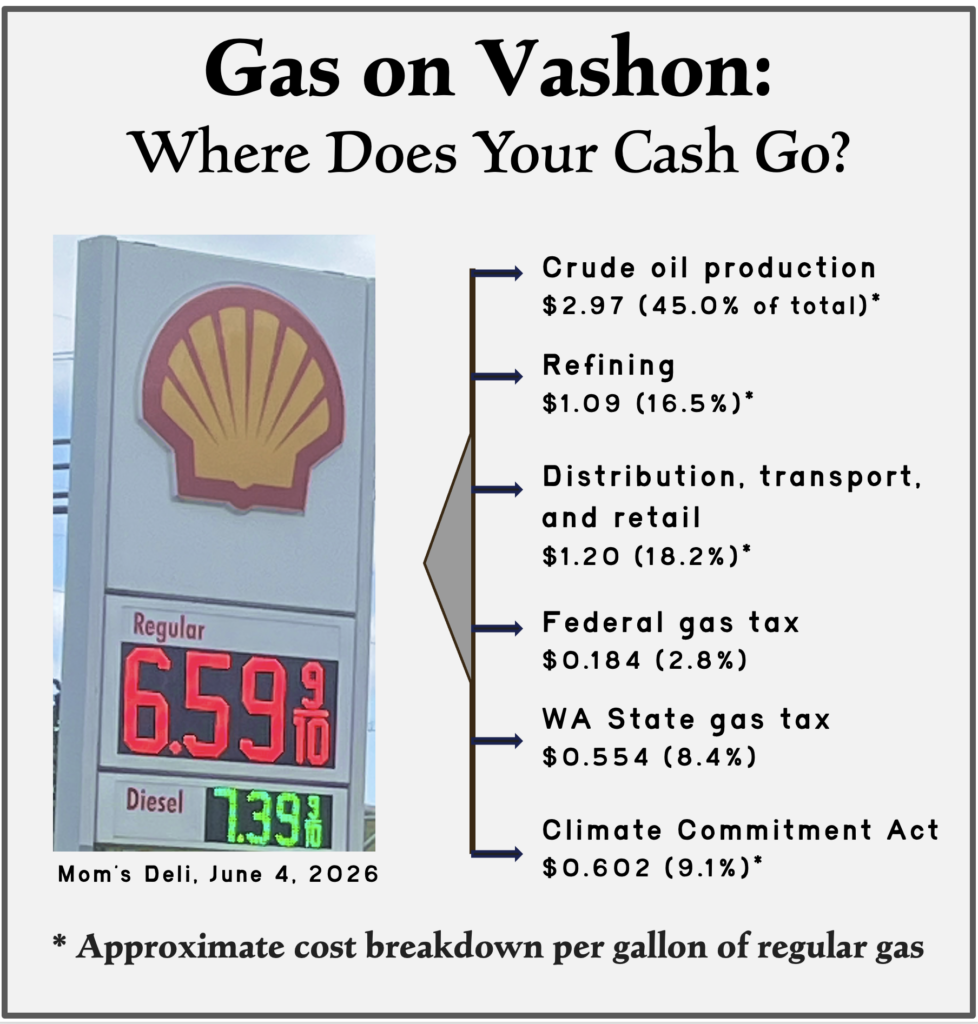
On June 4th, 2026, the price of gas on Vashon was about $6.60 for a regular unleaded gallon. But where does the money go?
The greatest expenses come at the start, for crude oil production and transportation, followed by oil refining. At about $4.00 per gallon, these factors make up more than one-half of your spend.
Recently, this cost area has increased in response to geopolitical instability in Iran and other areas of the Middle East. The U.S. doesn’t rely on Iranian oil, but, worldwide, global oil markets have reacted to concerns about supply disruptions, shipping routes, and potential threats to future production.
Next, refining. The cost to refine oil is actually higher in West Coast states than other U.S. regions. Geographically, the West Coast operates as its own, relatively isolated fuel network. We also produce specialized fuel blends, to meet our air-quality requirements, which are more strict than the rest of the country. This translates to our state having somewhat higher and more volatile fuel prices than other states.
After refining is another round of transportation that translates to about $1.20 per gallon and eventually brings your gas to Vashon. In Seattle, where gas on June 4th was about $5.90 to $6.10 per gallon, you would expect this second transportation phase to be less expensive.
What about the gas station itself? What is its direct income? It’s hard to get a precise estimate, but one industry source estimates that independent stations gross 10¢ to 15¢ per gallon. However, this profit falls to 3¢ to 7¢ after operating expenses – mainly, credit card fees – are taken into account.
Next are taxes. The Federal gas tax is 18.4¢ per gallon. This has not been raised in 32 years. In 1993, President Clinton increased the tax from 14.1% as part of a deficit reduction. Back then, gas was $1.10 per gallon.
Washington State’s gasoline excise tax is currently 55.4¢ per gallon, and it was increased most recently from 49.4¢ in mid-2025. This tax is about to get higher. Starting July 1, 2026, the tax will rise annually by 2%, to 55.6¢ per gallon, to adjust for inflation. Expect similar summertime increases each year going forward.
Interesting fact: Depending on how it’s measured, we have the second- or third-highest gas taxes in the country – topped only by California, Illinois, and Pennsylvania. In lower-gas tax states like Alaska, Arizona, and Texas, per-gallon taxes range from 9¢ to 20¢.
Last are costs attributable to the Climate Commitment Act (CCA). Passed in 2021, the CCA was established with the goal of reducing greenhouse gas emissions by placing a price and incentive structure on carbon pollution occurring due to fuel use. To date, the program has raised more than $4.3 billion in funds.
Specifically, the CCA is a “cap-and-trade” market system, designed to sell carbon allowances to companies that supply gasoline and diesel in Washington. Sold at auctions, held several times per year, as well as in private sales conducted between companies, these allowances are currently priced at just over $65 per metric ton of CO₂. To control volatility, state legislation has put in place an $80-per-ton ceiling on 2026/2027 allowance prices.
In essence, companies must purchase state-issued carbon allowances to “pay for” the CO₂ emissions that will be generated when the fuel they sell is ultimately burned.
Importantly, the increased gas costs paid by the consumer due to the CCA are not strictly a tax, because fuel companies build CCA costs into overall prices.
The plan of the CCA is to gradually decrease the total number of allowances sold over time on the way to Washington achieving “net zero” greenhouse gas emissions by 2050. Net zero means that any greenhouse gases still emitted will be offset by an equal amount of greenhouse gases removed from the atmosphere, resulting in no net increase overall. We will see.
The revenue generated from CCA allowance sales is deposited into state accounts and appropriated by the Legislature for transportation, energy, climate, and environmental initiatives. But there are issues.
The first is mission creep and budgetary shenanigans. Both CCA supporters and critics are concerned that program revenue is being treated as a general funding source, “to backfill already funded projects and programs,” rather than focused on developing relevant projects with clear, planned outcomes.
Two recent examples: In the 2026 supplemental budget, Governor Ferguson requested to use CCA revenue to fund the state’s Working Families Tax Credit. Likewise, legislation approved in 2026 directed hundreds of millions from surplus assets of the overfunded LEOFF 1 retirement system for retired law enforcement officers and firefighters into the CCA, to repay prior fund transfers and stabilize the account’s finances.
The second issue is whether the underlying plan is feasible. In January 2026, state officials disclosed that a data-entry error had substantially overstated emission reductions attributed to some CCA-funded projects. A report that initially estimated 8.6 million metric tons of greenhouse gas reductions over these projects’ lifespans was later corrected to approximately 308,000 metric tons – only 4% of the original amount.
Critics have also argued that Washington cannot adequately evaluate the effectiveness of the CCA because statewide emissions inventories have been released years behind schedule.
It is not possible to explain the price of gasoline through any single factor. At the same time, the list of things we are paying for with each gallon continues to grow and now extends beyond the traditional costs of producing, refining, transporting, and selling fuel. The next time gas prices rise, you will almost certainly hear someone attribute it to a single cause. Reality, as usual, is much more complicated.
