Part Two: The Falcon’s Nest
By Richard Odell
from Part One: “My parents would one day move to that island, and within a few years find themselves, by choice of housing, connected by an overgrown lane to the source of that pillar of smoke, a mansion that now lay in ruins. I was but five months old. Discoveries lay in wait.
Alexander was not the only figure of wonderment to loom above the borders of my New World. Nor were his beams and culverts the only legacy of enchantment. Our driveway, the entry of which was guarded by two stone pillars and an ornate, rusty, wire gate, was really only a piddling segment of a much more ambitious, but now overgrown lane that ran a quarter mile south before splitting.
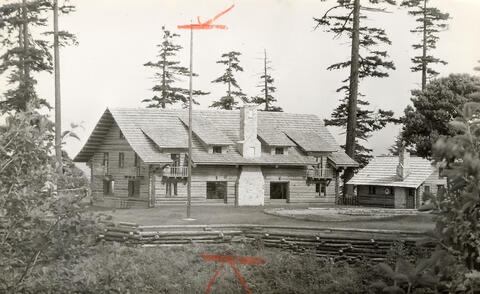
One fork ran west, to reunite with the Island’s main highway, to which it presented the reiteration of two more stone pillars. The other ran east, to the source of this audacity, or what remained of it: the gray ruins of a mansion called The Falcon’s Nest; the work of a man few then could name, but who once afforded himself two long and landscaped driveways, one for a trip to the northend ferry, another for access to the Island at large. From here had risen the black pillar of smoke my parents had witnessed from West Seattle.
All that remained of the mansion was a deep and vast basement overseen by two stone chimneys; their fireplaces, with hearths of slate, poised over the nothingness. One fireplace evidently served the main hall, the other seemed meant for what we young explorers deemed the servant’s quarters, but more likely it was the master bedroom. A naked flagpole yet stood, and a bunkhouse, a circular drive, and a horse stable now dark and crumbling in the shade of Blue Spruce trees.
By the time my siblings and I would wander onto the grounds, the half-life of occupation had diminished to where the place had an untouched quality about it. It was left to itself, but strangely, to us kids, as well.
For a long while, no one else on the Island had the same relationship to the Falcon’s Nest as we did. Our driveway was the driveway to the great estate. With intersecting ravines all about, the only residence even scarcely adjacent to it at the time was our own. As with Alexander’s lumber, we seemed entrusted. Sometimes we’d bring friends. More often, for me, it drew the lone pilgrimage.
Down a short slope from the backside was the tiny bunkhouse of stripped logs, its polished interior still a warm, honey color. Such an inviting sort of place, still sunny and clean, with crispy, dry madrone leaves gathered in one corner. My brother confessed to me, some years back, that he and a friend he had damn near set the place on fire. They’d lifted a Ronson, somewhere, I guess, and had to try it out. Perhaps they’d been caught up in an echo of time.
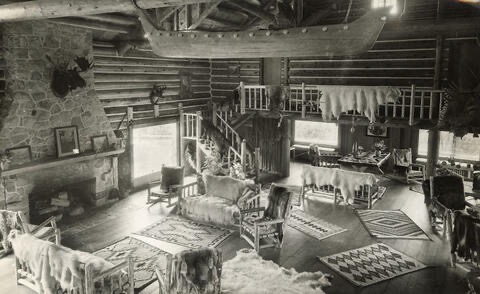
From the ashes of the Falcon’s Nest there rose a legend, and a familiar theme: There had once been a man of means, a man who could buy whatever he wanted, but for the thing he wanted most of all: the love of a certain woman. Even so, he took his wealth and built a great mansion that looked east, over the waters of the Sound, to the mountains in the distance. From the mighty beams of his new estate he hung a native longboat. On the grounds he planted deodars, blue spruce, and rhododendrons, and along the long entry lanes Mountain Ash, Norwegian Spruce, and English Holly.
“Come live with me,” he called to his love, but she spurned him. And so with torch he set the longboat on fire, and from his spacious grounds he watched as the flames took down his ambitions.
Well, not exactly. Definitely, our visionary builder sold out, and quit the scene, for whatever cause.
All became grounds for a local elite, and gay, old times, with one fatal oversight in their carefree world, the un-spannable distance between the mansion and the nearest fire hydrant. Even so, word of the flaming longboat still gets bandied about, evidence hard to ignite or ignore, a flashpoint for shattered dreams, if ever there was one. In any case, heartbreak for sure.
Come the mid-sixties, a shock to our hidden Wonderworld: a small, plywood cabin appeared overnight at the edge of the yawning basement. Our trusteeship had been usurped. My brother told me he and his Ronson lighter buddy had looked inside and seen a sword and a human skull in a glass case on the floor, but I never dared to approach and confirm.
Yet now and then, I’d find myself following the trail along the overgrown lane, edging my way, under camouflage, near that now lost world. Never were there cars about, or any sign of life about the cabin. Come ’67 or ’68, though, a most visible and colorful presence would take up residence, there, with camper trucks on the outer grounds. The hippies would arrive on Vashon.