
By Andy Valencia
EV’s are in most ways simpler than their internal combustion engine cousins. There really just need to be batteries, a controller to send power to the wheels, and a charger. But these parts work hard, since we want fast recharges and even faster acceleration. Stressing electronics means failures will show up eventually. And there’s always the chance that somebody just crashes into you and breaks something.
Either way, your car is out of commission. Then what? A trip to the EV “hospital,” of course. But no local mechanic on Vashon has the facilities to do these highly specialized repairs. Like so many other things which don’t exist here on-Island, you must look off-Island instead.
This was what faced one Islander we found. His Tesla was involved in an accident bad enough to disable it. A tow truck hooked it up in the manufacturer-approved fashion and headed to the ferry, only to be turned away by the ferry workers. The Tesla owner tried a second time with another tow company, and was turned away again.
At issue was a new policy for Washington ferries, as of November 2025. Damaged and inoperable EVs – including hybrids – may be required to supply special documentation in order to board. Specifically, a technician must fill in and certify that the vehicle’s systems have been rendered safe, typically including that the high-voltage system has been disconnected. Unfortunately, nobody seems to know how to get such a technician onto Vashon.
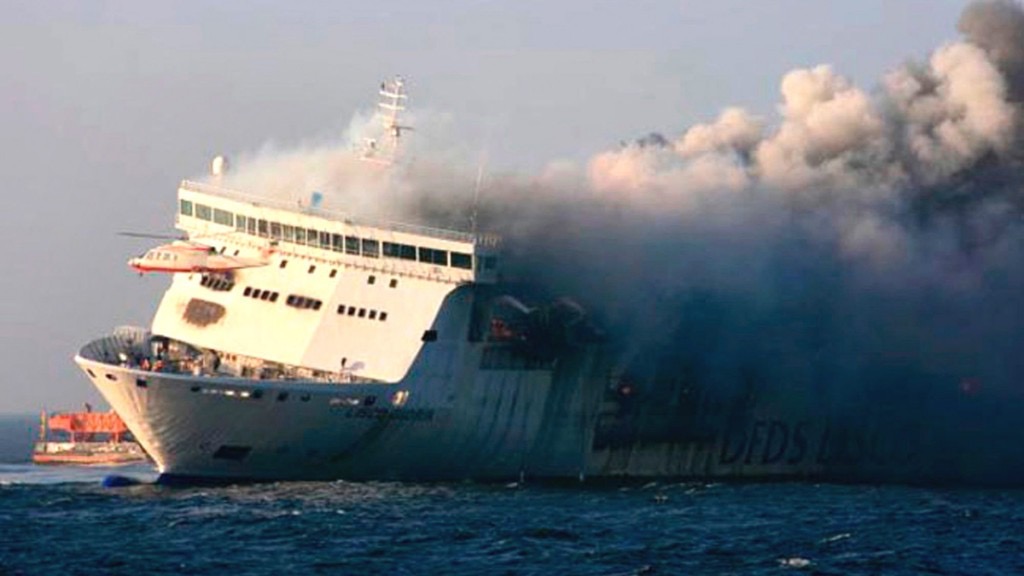
Do an image search for “EV fire on ferry” to get idea of what’s on our ferry system’s mind. You just want to tow your dead EV onto the boat, cross, and be on your way. WSF wants to help you with that, but they also don’t want their boats getting singed in the process. Thus, the new policy.
Where to find a technician? We asked WSF. Although they told us that they had focused on outreach to tow companies, we have yet to find one that remembered any contact from WSF on this subject. We don’t know how to find a technician, and WSF pointed us to the tow truck companies. None of them seem to know, either.
We then contacted the local Toyota service people, and once they understood the issue, admitted that they weren’t sure what to recommend to an Islander in this situation. It’s been kicked up the management chain at Toyota, but we’ve heard nothing else by the time of publication.
Tesla was even worse, since we never actually talked to a human. After bouncing around their phone system, we were asked to rate their robotic service (“awful”), and then the call was disconnected. We reached out to their North America press contact – again, there’s been no word by time of publication.
We’re still hunting rumors of an entrepreneur in the Seattle area who offers a mobile service to come to your disabled vehicle, safely disconnect its high voltage system, and fill out the needed paperwork. So far, we’ve only found a few defunct web sites, plus a mobile EV battery service which – so far – does not want to provide this service.
The Loop will keep looking, and we’ll provide updates as we discover better options. In the meantime, if your vehicle’s health systems tell you to visit your dealer, drive over while your car’s still in good working condition. If you have any reason to think your car isn’t safe – do not drive it onto a ferry! If a fire is going to happen, a ferry is one of the very worst places for it.
Even as The Loop researched this article, we noted that WSF’s own Wenatchee vessel, converted to be a hybrid EV, has entered service. Holding 864 battery modules spread across a pair of compartments, we wondered what sort of safety systems would be built to protect battery banks at this scale.
Unfortunately, WSF could only point us to their general information page for fleet electrification, which does not address this issue. Industry literature makes it clear that fire suppression for large battery banks is an area of ongoing research. We’ll update you as new information becomes available.
Gasoline-powered engines have been around for almost two centuries, building up a body of experience in how to safely and efficiently use them. The high energy density of modern batteries has already picked up stories of burnt phones, laptops, and cars. Safety practices are in flux – can you use a USB power bank on a plane? How many spare batteries can you pack? How many EV’s will your ferry carry at once? (An April 2024 policy limited Alaska Marine Highway System ferries to two EV’s per run.)
Your EV may feel like a mature product, but in some ways you are still an early adopter. Good answers will emerge, and in the meantime bring patience and flexibility to any surprising situations that come up. If you have a good story to share, let us know! editor@vashonloop.com
