
By Caitlin Rothermel
For a practice built around slow breathing and gentle movement, qigong has had a surprisingly turbulent history. Originating in China and thought to date back more than 2,000 years, qigong has moved into favor, out of favor, and eventually back into favor again.
During the “qigong fever” of the 1980s and 1990s, tens of millions practiced it publicly across China. Reasons for this popularity included a growing interest in spirituality and traditional culture (after a long period of repression in those areas). Qigong was also considered a health practice that was believed to improve well-being without medication at a time when the country’s healthcare system was under stress. Qigong was also inexpensive, communal, and very likely just made people feel better.
But some qigong organizations grew rapidly in size and influence, leading the Chinese government to see them as challenges to their state authority. That tension culminated in a 1999 crackdown on certain qigong organizations, including the Falun Gong, a movement with a charismatic leader that styled itself as a spiritual religion (and is now headquartered in the United States).
Today, qigong is again legal in China, although public instruction remains regulated by the state. Worldwide, qigong is now practiced by millions of people, including here on Vashon.
Beginning this May, Vashon is invited to gather outdoors near the pond in the Japanese Garden at Mukai Farm & Garden on Thursday evenings at 5:30 p.m, where instructors Arlette Moody and Lynelle Sjoberg will lead qigong classes.
Qigong is not one fixed system. It has been described as a way of working with “qi” – often translated as life-force energy, and pronounced “chee” or “ji.”
Broadly speaking, qigong draws from martial arts, Tai Chi, meditation, and traditional Chinese medicine. It combines breathwork, coordinated movement, and body awareness with the goal of improving balance, flexibility, relaxation, circulation, and overall health, including the health of the body’s organs and energy systems.
This variety is part of what drew Arlette and Lynelle to qigong. Arlette has a background in dance, Pilates, and martial arts, and found herself circling towards qigong through movement practices she was already exploring. “I did it unknowingly,” she said. “I’m a dancer. I’ve done martial arts. I love movement. And the more I started to play with this, the more I would come up with repeatable patterns that were tied with breath.”
Lynelle came to qigong through yoga, Tai Chi, dance, and an ongoing interest in movement and the body. “I consider it energy medicine.”
Although qigong has roots connected to martial arts, both instructors emphasized that the classes are slow, accessible, and definitely non-combative. Instead, much of the focus is on breathing, coordination, posture, relaxation, and awareness. According to Arlette, “Everything is about getting the benefit of the movement internally. It’s all slow – it’s all smooth … Chi flows best when you’re relaxed, so a lot of qigong is practiced with 50 to 70 percent effort.”
That emphasis on relaxation may be one reason qigong often attracts older adults, although younger people are increasingly interested. Arlette noted that qigong is an excellent example of a movement practice that can be sustainable over a lifetime. “A big thing for people, especially as we age, is learning how to relax and how to move in a relaxed way.” This is important “so that we’re not blocking blood flow and creating too much tension in our muscles.“
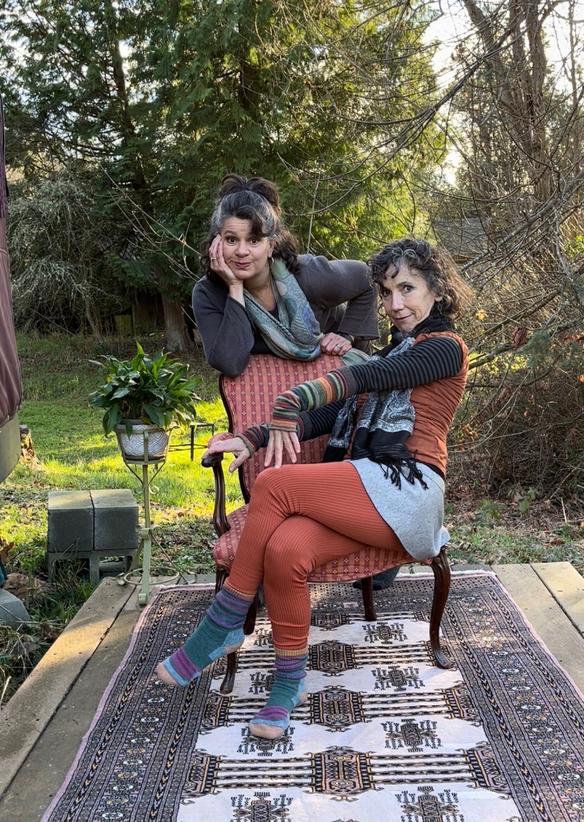
Arlette Moody (standing) and Lynelle Sjoberg (seated
Lynelle said, “Qigong makes you slow down and become more mindful, more present about what you’re doing … you’re learning about how your body works and key movements that calm the nervous system.”
Arlette contrasted qigong to a conventional gym workout, where “We use this machine and pound; everything is all about breaking a sweat.” Qigong is more like a moving reset, “You walk out feeling reinvigorated, able to let go of stuff you’re always thinking about and worrying about.”
Lynelle agrees that qigong is very meditational: “You’re using the mind to direct the body and then you’re letting the chi just kind of take over once it gets going in the right direction.”
Qigong is also accessible. Unlike some movement practices, qigong generally doesn’t require specialized clothing, equipment, or athletic experience. “You don’t have to lay on the ground, you don’t need your special yoga mat, you don’t have to have a certain level of anything,” Arlette said.
The qigong classes, previously held indoors, will meet starting May 21st outdoors near the decorative pond at Mukai Farm & Garden. The location, with its grasses, water, and quiet open space, feels particularly suited to a practice centered on slowing down and paying attention.
The suggested class donation is $20-25. You can show up for class, or, if you would like to receive more information or join the mailing list, contact Arlette or Lynelle at arlettekehenquet@gmail.com or lynellek.s@gmail.com.
