Part Three: Wingehaven, Shakespeare’s Shack, MacDonald’s Farm
By Richard Odell
Mike Sudduth, classmate, fellow Beall Greenhouse potting-shed drudge, and Vashon historical researcher, lent a hand with this article.
Down deep into the canyon below the Falcon’s Nest, down to where you could hear waves break on the beach, you came upon another monumental relic; a nestled world of its own that died quietly while a war raged elsewhere.
But a young family had come to live and play there, now, and my brother and I came to play there, too. This new family named the grounds Wingehaven, after themselves, hanging one more shingle on a place that had borne a few. The appellation of its glory days, “Twickenham Estates,” had by then been forgotten.
It’s yet rumored bootlegger money got involved there, at some point in its checkered past. Any such might have been at home amidst the New Money ostentation, evidenced by the high concrete bulkhead, with the balustrade and boat-launch, the fountain and brick barbecue, the circular drive lined with boxwood, the tennis court, the five-car garage, the bungalow, and the apple orchard.
Higher, still, up the drive, was the dense, dark, filbert orchard and the broad Koi pond, which, in Carl Winge Sr.’s opinion, might have held more bottles of hooch than it ever did fish, though reports on file tell of aquatic enterprises supposedly wiped out by flash floods (rather strange, in an otherwise dry sort of watershed). I may be dense, but I saw no sign of the other twelve fishponds or the two swimming pools supposedly there. In any case, all this was left for whoever might share the wavering candleflame of its last hour.
Throughout the years, whenever I would read stories played out on grand estates, I’d place Wingehaven as a setting in my mind, yet when I returned there some years back, to visit the youngest Winge in her little cabin above the apple orchard, I saw the old foundation of the vanished house and was shocked by how small it now seemed.
It was a good house, not a great house. True, it had been struck once by fire, handily quenched by the same luckless soul, a Mr. Taylor, who shortly before had suffered the flash flood (fire and rain in one spell, for Mr. Taylor). Perhaps some parts had gone missing. It had a tiny den for dad, a stone fireplace, a roofed deck, morning sunshine, a broad green lawn (which subsequent residents would pay me to mow). The upstairs quarters were rather cramped.
Perhaps here was the key to the shortfall of what might have been: that after the high bulkhead and balustrade, the boat launch, the brick barbecue, the fountain, the circular drive with the boxwood hedge, the tennis court, the apple orchard, the bungalow, the five-car garage, the filbert orchard, and the koi pond, enough cash was left only for a house any flush, 20th century American middle-class family might build for themselves.
~
Men built monuments to themselves, only to have their names go missing. Yet who was Shakespeare, one had to wonder, and why did the little shack he left behind still bear his name, even after being all but overcome with blackberries and alder?
Up Cunliffe Road, from Wingehaven, you and your buddies paused your walk near the top of the ravine, where you could hear cars rushing by on the highway above, and looked down into the brambles at the blackened-cedar, toothless old abode, now falling in on itself. “Shakespeare’s Shack,” someone intoned, and let it go at that. You pictured some old, secretly wise misfit, known only to the children, whose life ebbed away just as the blackberry canes, in perfect harmony, broke upon the roof.*
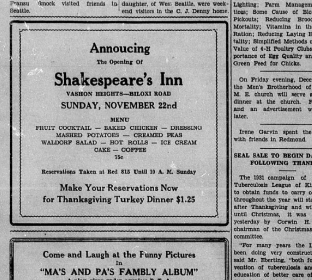
*Our own William Shakespeare, it turns out, was an energetic entrepreneur of the ’30s, whose many exploits included a milk and bakery route, one which likely placed him on the doorstep of many Islanders. Small wonder his name long outlived him.
~
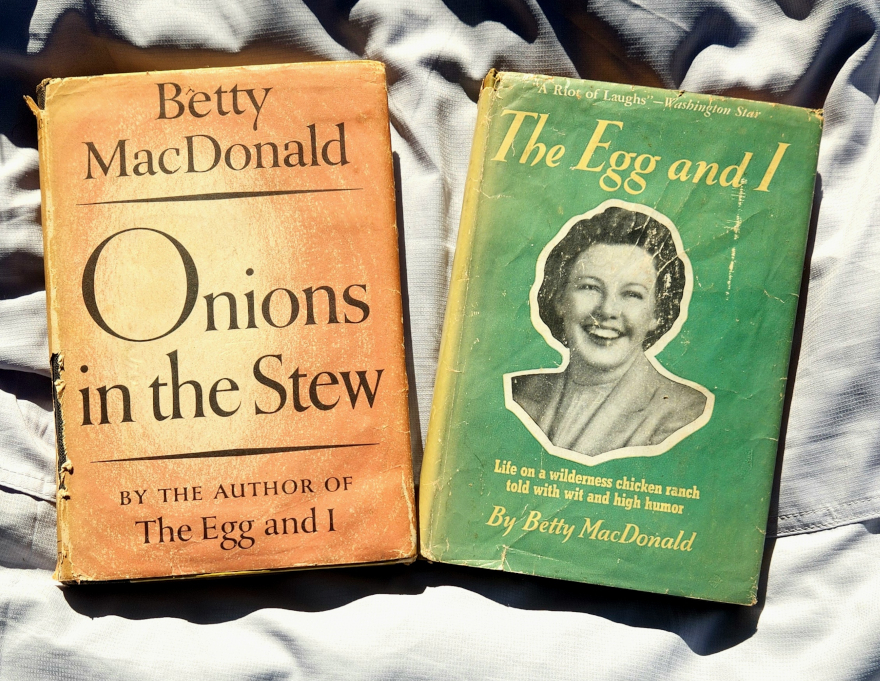
Continuing along Cunliffe, just before one met the main highway, there was, on the right, a little footpath carved out by my brother and his buddies. It led back through the trees to MacDonald’s Farm, which back then was abandoned. This was not the MacDonald of song, but of prose: the noted writer Betty MacDonald of Onions in the Stew and The Egg and I, both of which put Vashon on the map for a spell. Her story of the orphans, Nancy and Plum, was read to us by Mrs. Graham in second grade. Her Ma and Pa Kettle characters found work in Hollywood. We kids had the run of the place now, though, with the decent house being inexplicably empty.
In the loft of the barn there were stacks of Life magazines from the fifties. Whether these or any of the other artifacts we found there had been Betty MacDonald’s, one couldn’t be sure. Nor could it be determined that the homebrew my brother and the eldest Winge kid – the same cohort with whom he’d nearly torched the bunkhouse at The Falcon’s Nest – had found and then stashed along the footpath, had any literary heritage.
They shouldn’t have shown me the cache, but they did, and I suppose it had to happen. And I suppose it would make a good story, my getting drunk for the first time ever, at age 13, on Betty MacDonald’s beer. Upon reflection, it would explain a lot. But that would have made the beer pretty old. In closing out my mother’s estate, I found tucked away among her files an obituary done for MacDonald by the Islander News Record. McDonald and family moved away to a cattle ranch in Carmel in 1955. No surprise, there. In 1955, when you’ve got it made, you move to Carmel.
One day, my brother brought home a prism from the barn at MacDonald’s. There seemed no shame or guilt associated with this bit of plunder. For a while, the three-inch, triangular shaft sat on the sunny windowsill above the kitchen sink. Often in winter, when the sun was low, I would study the little rainbow it cast on the spice cabinet. Sometime later, my mother transferred the piece to a sunless place above the dining room buffet, at the end of the railing that held her teacup collection. It was still there, some 40 years later, as I gathered the teacups and packed them away.