By Jane Valencia
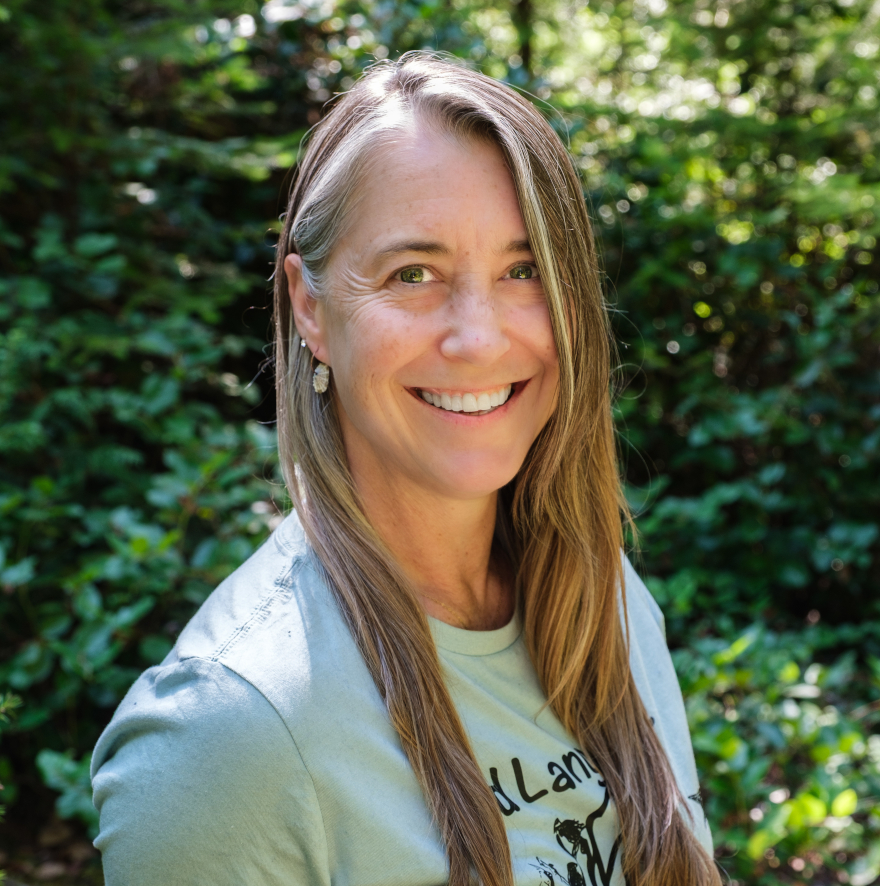
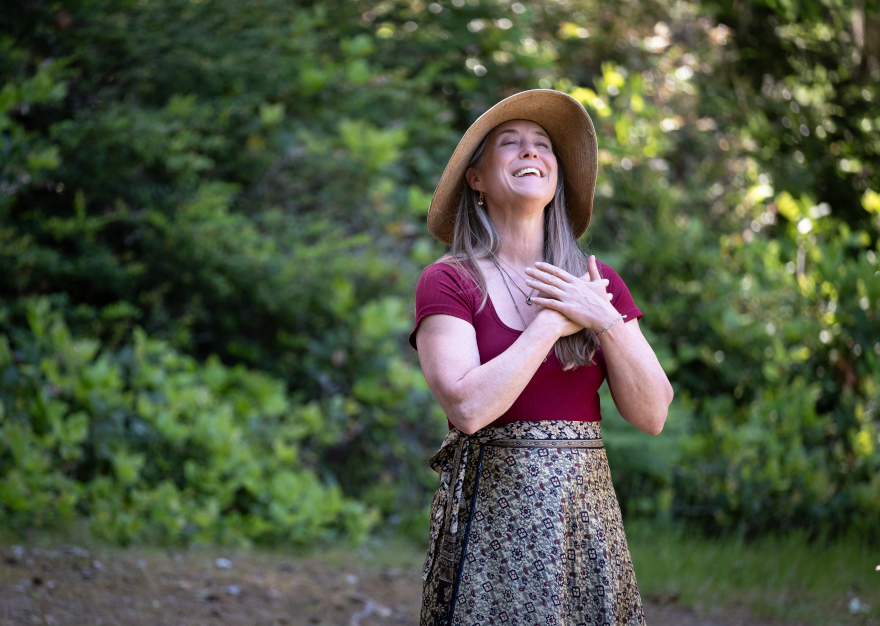
In Part 1, printed in our March issue, we heard the story of how Nadja Vol Ochs came into nature connection work and onto the Island. In Part 2, we learn about her role as new executive director for the Vashon Wilderness Program (VWP).
Stacey Hinden had been VWP’s first and only executive director in its 20-year history, when Nadja stepped in. Stacey mentored Nadja and taught her the ropes of the position in a transition that took a month:
“What shoes to fill! What Stacey did with me that month was incredible. You never get that when you start a job, you just get plunked in, boom, ‘There you go, bye, I’m out,’ But her humility, her grace, and the whole team – everybody was just so welcoming and warm.
“I feel like that got me off and running so smoothly, and plus having been an executive director at two other organizations – a farm and an art school – I had a lot to draw on from those experiences. A lot was familiar territory. But it was also new and fresh.”
Nadja has been with VWP now for a good nine months, in what she considers to be a year focusing on grounding.
“I think by the end of the cycle, the program year, I’ll have a sense of what can I refine, what can we improve on, what can continue to foster.”
First and foremost, she is getting to know the program families, as well as in the larger community.
“Being there at the beginning of programs, talking to the parents, and offering time to just walk, talk, and hear where their needs and challenges are. Is it with ferry commuting to the Island, or carpooling needs, is it curiosity about our core routines? Do y’all know what ‘sit spot’ means, things like that.” Please read the accompanying article by Nadja.
“Listening to the community – and then looking to where can we shout from the rooftops, ‘Hello Tacoma families, hello other areas, West Seattle.’ We’re trying a couple camps in West Seattle this summer, just to meet more families off-Island and bring them out here.” Reaching more urban families is a particular intention.
Nadja strongly believes in partnerships and the resilience they cultivate for organizations and communities, and is at work establishing new partnerships for VWP, both on and off-Island.
Recently, VWP partnered with The Land Trust and the Vashon Heritage Museum to present a free World Storytelling Celebration, “Once Upon a Place.” And, off-Island, VWP has just launched a new program in partnership with Parks Tacoma and the Tacoma schools for their “Beyond the Bell” afterschool activities. VWP will also be offering a multi-location fly-fishing camp in partnership with Emerald Water Anglers.
Other new themed offerings for summer camp are a Teen “Shadow Camp” with an overnight at Camp Sealth, and, in West Seattle, a “Hidden Worlds Camp,” which “invites children to explore the tiny, magical ecosystems all around them – both real and imagined.”
I noted that a couple of these new camp offerings involve the waters. Might there be an expansion of the water curriculum in VWP’s future? Nadja lives part-time on a boat, after all!
Cultivating a relationship with the water is indeed a compelling thought to Nadja:
“There’s so much more we can do with the waterways, and the sea, and being surrounded by it.” Noting that the nature connection work began in the forest, Nadja says, “A lot of the core routines are tied to forest, and less to ocean. There’s something calling here to weave some of our practices that are related to the water. My sit spots, sometimes, are on the water.”
Again, partnerships may be a way to grow water-centered offerings. Nadja notes, “The Vashon Land Trust is working on the watersheds, and with the salmon, and doing land conservation work, and so, I think, the work is to listen in and see where we fit in with all of that. And then consider, what are the resources our staff needs to learn to teach more Salish Sea connection. How might we weave that in – currents and tides.”
I note that Nadja has a lot of skills, including mentoring. Is she interested in doing more mentoring with VWP?
Nadja is definitely interested. In addition to co-mentoring this summer’s Hidden Worlds camp and “Nature’s Canvas Camp,” this year she led a bird walk with the Vashon Bird Alliance. Inviting others into her passion for the birds is something Nadja loves to do. However, in service to developing a full grasp of all the pieces of the organization, this year Nadja has deliberately keeping mentoring to a minimum.
“There are so many things I learned at Wilderness Awareness School, and just what I love to do in general, that would be great to offer.” Basketry and making natural pigment dyes are just two examples.
VWP’s curriculum continues to include nature skills such as tracking, bird language, edible plants, elemental living skills, and natural history and heritage. An addition in recent years has been to include some Twuhlshootseed language learning.
Twuhlshootseed (Lushootseed) is the indigenous language of the first people of our Island and the Puget Sound region. David Turnipseed, a language instructor with the Puyallup Tribal Language Program who has children in one of VWP’s weekly programs, has taught aspects of the language, and various words and phrases, to VWP’s staff. The staff continues to pursue their learning in order to share Twulshootseed with the children.
Nadja ponders the challenge of learning a new language and making it stick.
“There is lots of technology for learning language, but you’re not talking with people. Weaving the language into play is something that we have a huge opportunity to pursue. When one of our mentors dressed up as a bəlups [raccoon), I thought, yes, this is amazing. This is what makes learning fun and engaging.
“What our style of mentoring really does well is that we’re teaching you the words where you’re experiencing the language. The more we can weave those experiences in, the more the words will stick.”
Songs, words, and phrases used again and again build that familiarity.
“Anything we can learn to tie us to the context of and the peoples of the place,” is what is sought in this venture.“
In closing, Nadja wants to express her gratitude to the community she’s gotten to know, and for the layers of support that VWP enjoys. This brings us to VWP’s core routine of practicing Gratitude.
”In this time, there’s so much heaviness In the culture regarding what’s going on in the world and the politics. But we can ground in gratitude. That’s something that we practice at VWP. And whenever I’m in a conversation that doesn’t start with it or end with it, it feels like something’s off. It becomes so natural to be grateful, to live in gratitude and have that attitude of gratitude stick in you. That’s something that I feel like our community supports so well. I couldn’t live without it.”
Gratitude as a “core routine” was introduced into the nature connection field by Jake and Judy Swamp field and is a cultural practice in nature connection schools worldwide. That said, the practice of gratitude is cross-cultural and ancient, and Nadja notes that, these days: “Psychologists use it, therapists use it. You can read about it anywhere. It’s tied to religions. All kinds of aspects of gratitude practice weave in and out of our social sphere and spiritual ways of being.
“When you kindle that gratitude fire, it just keeps going. Just to hear the kids’ gratitudes and those of our team is connective. It’s not divisive – we need connective practices in our culture right now. Gratitude is regulating. It’s grounding.”
As Nadja completes her first year as VWP’s Executive Director, she finds that there is so much to be grateful for. And, indeed, it looks like her boat is well-launched!
Visit Nadja Vol Ochs and VWP at vashonwilderness.org