
By Marc J. Elzenbeck
Imagine it’s 2006 and you’re looking to buy a subcompact car for parking in tight spaces and weaving through some of the heaviest urban traffic tangles in North America four times a day. A connoisseur of fine engineering, let’s say you’re also a bit large, at 6’ 8”, and tip the scales at 350-ish pounds. The rest of your hierarchy of crazy vehicular needs would seem to rule out every subcompact option.
Best-in-class crash safety ratings are a must for your family, and you need ample rear space for car seats for two kids under four years. You’d prefer a combined fuel economy over 30 mpg, demand the lowest total cost of ultra-reliable ownership of any car on wheels for 400,000 miles, and want its handling to make you smile as wide as a Mazda Miata convertible. The interior should be huge, as it must occasionally swallow two mountain bikes, a surfboard, or 8-feet long pieces of lumber. Ideally, you’d also like to convert it into a tiny camper in 5 minutes or less.
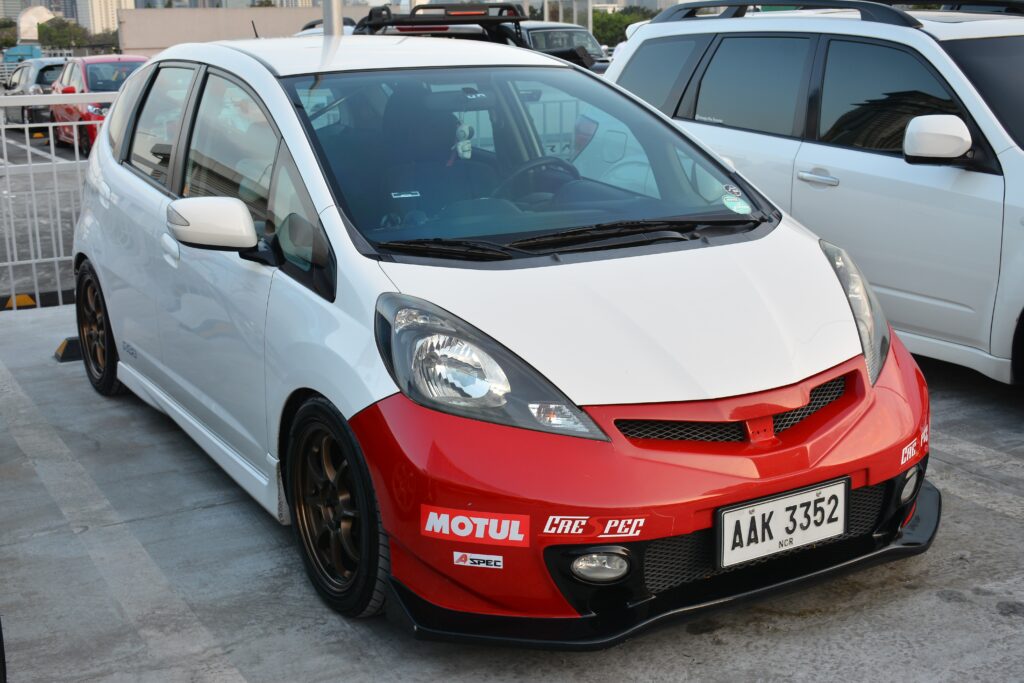
Though not yet 6-foot 8 nor 350-ish, I was basically that car shopper in 2005. Prospects were looking dim, then Honda announced it would bring its internationally popular Jazz into the U.S. market and re-name it the “Fit.”
The March 2006 issue of Car and Driver magazine did a seven-car subcompact test, “$15,000 Cheap Skates.” The Honda Fit won the bake-off by 25 points in a “cakewalk.” It averaged 35 mpg, scooted from 0 to 60 in an acceptable 8.7 seconds, and received the kind of praise I was looking for:
“Despite its midget proportions – the least width and length, riding on the shortest wheelbase – the Fit will swallow an amazing 42 cubic feet of household miscellany when its rear seats are toppled. And they fold quite cleverly, without removing the headrests, into a deep well, making the cargo floor as flat as a trailer park.”
Forty-two cubic feet of storage is bigger than the bed of a Ford Maverick pickup’s 33 cubic feet, and the Gen 2 Fit’s capacity expanded that to 52.7 cubic feet.
But something else jumped out – far, far out – and on first reading I was sure it was a typo: the Fit did the emergency lane-change maneuver at 71.4 mph. If true, that was the fastest speed ever recorded for a street-legal vehicle sold in the U.S.
By comparison, a Toyota RAV-4 could only perform the same maneuver at a maximum of 56 mph as it flirts with rolling over. A Porsche 911SC Turbo or Corvette Z06 will do it at about 68 mph. A 2005 Ford GT, a racecar lower than a Labrador on sticky rubber, had just done the same test at an impressive 70.1 mph. How, then, was it possible for a five-foot tall econobox on lowball tires to beat that?
Having geeked out on car design in high school, I suspected the Honda Fit must have a very low polar moment of inertia, close to or below the magic 1,000 kg/m2 design milestone.
Polar moment? When you see a figure skater go into a spin, she’ll lower her body’s polar moment of inertia by pulling her arms in and even tucking her head down so she’ll spin faster. Likewise, it’s much easier to spin a short 20-pound dumbbell than a long 20-pound barbell – same with stopping.
Honda decided to build the 10.6-gallon fuel cell into the center of the Fit’s chassis, so most of the Fit’s mass sits not outside its tires, but much nearer its center. Combined with a short wheelbase, fairly low center of gravity and weight, this makes it extremely good at changing directions. World-class good.
In effect, the Fit is a cheap mid-engine supercar with a tall roof, and it really does drive like a Mazda Miata. (Sadly, without a convertible top.) This plays right into lots of other good things.
In Europe, every vehicle must pass the 45 mph ISO 3888-2 Standard “Moose Test.” Prudent roll-over hating Swedes developed it in the 1970s as a benchmark for a vehicle’s handling dynamics, capabilities, and limitations. You approach traffic cones at 45 mph, lift throttle, steer around, and go back into your original lane. Then you try to do it faster.
It’s not about crashing into a moose, more about avoiding one suddenly looming in the road, as Swedish moose love to do. The test gained fame when a 1997 Mercedes-Benz A Class flipped onto its roof at a mere 37 mph, leading to an embarrassing recall and Electronic Stability Control. Twenty years later, the Fit (again, “Jazz” internationally) still has one of the highest Moose Test scores ever recorded. For driving on Vashon, just think “Deer Test.”
The Fit also has Magic Seats. For real, that’s what they’re called. They pivot away, they clamshell, fold down, and come all they way out. You can fold the front seats all the way forward and use the passenger side as a recliner. You can fold everything flat and turn the whole thing into a tiny camper in 5 minutes. People are buying insulated window inserts online. It defies most description, so I’d recommend watching videos.
What you can’t buy is a new Fit because Honda discontinued them for the U.S. in 2020. Seventy other countries get them, but not us, with Honda mumbling something about CR-Vs and demographics. This is not good. Honda plowed about $100 billion into an electric vehicle apocalypse, then pulled the plug on new factories in the U.S. and Canada, writing off a first $16 billion loss this April.
Hope you like Hondas the way they are, because in the interests of solvency, all new designs are delayed until after 2030. Dear Honda: Bring. Back. The. Fit!
I went out and bought a Honda Fit, and miss it. Not a perfect car. The ride is jouncy over bumps, the ground clearance is a little low for rugged roads, the roof pings like a tin can when it rains. The fuel filler lid can stick, the rear bumper covers scratch easily and often look like they’ve been chewed on by a flock of sheep.
But there are ten cupholders and, with normal maintenance, the mini-ride will really last 400,000 miles, in surprisingly good shape when not rear-ended.
The Loop’s other editors, Andy and Jane, wrote a fun kid-oriented series “Tomtomtidimiddletom” about some sort of tree growing in their first Fit. That car was totaled after a rear-ending, so they just bought their second 2nd Gen.
For many fans like them, there is no better car, with cult resource sites like FitFreak.com and influencer devotees like Scotty Kilmer and Car Wizard on YouTube (links included at VashonLoop.com). Word has gotten out and the party has finally started on prices, but you can still get a 1st Gen in decent condition for under $5K.
And the 6’ 8”, 350-ish guy? That’s my bouncer friend, Scott. Just saw him in Tacoma on Wednesday and took his 2016 Fit for a spin. I didn’t ask his exact weight. No one does.
