
By Anthony Latora
As the days stretch into longer light and the warmth in the air begins to carry the fragrance of new blooms, nettle rises from the somber earth. For many, this plant is known through accident, or by the warnings of caregivers who remember its sharp, lingering sting. Yet what if that very sting has long been used as medicine in its own right?
Plant lore tells of people who deliberately welcomed the sting, finding relief from arthritic pain and stagnant joints. This practice, still used today, invites a different relationship with the plant, and, beyond the sting, nettle offers far more. When cooked, steamed, dried, frozen, or tinctured, the formic acid compounds in its hairs are neutralized, leaving behind a nourishing plant. With practice, one can find themselves harvesting by hand with courage and respect.
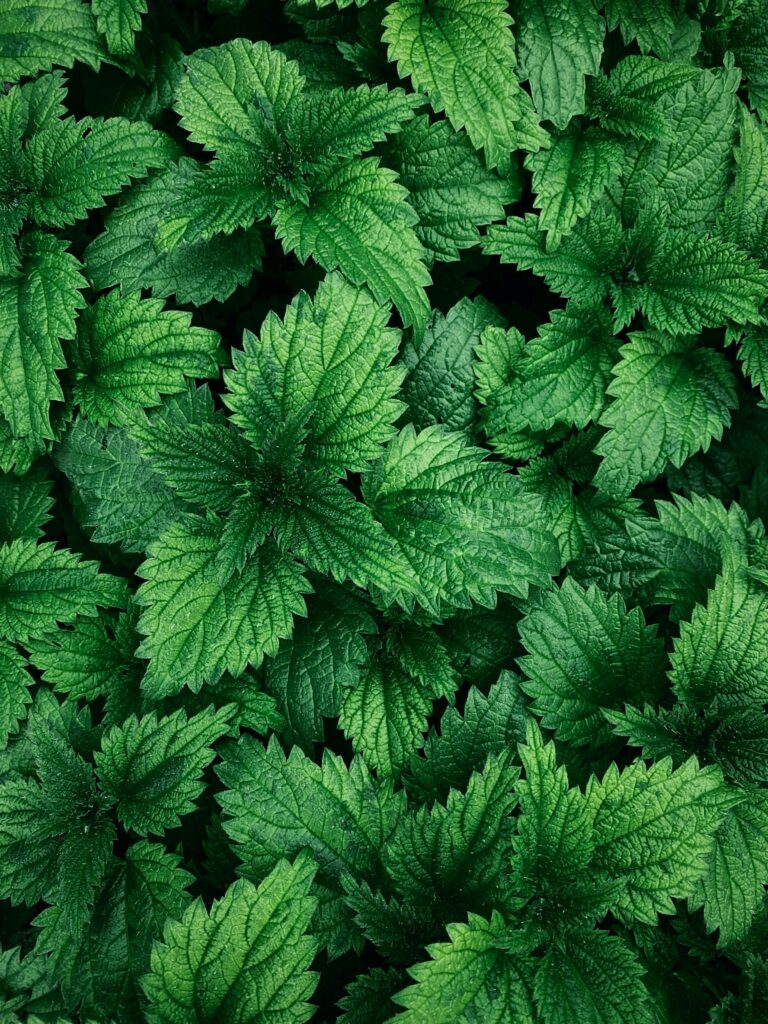
Nettle grows with opposite leaves and square stems, reminiscent of the mint family. Its deep green leaves range from rounded to lance-shaped, each edged with fine serrations and tapering to a point. The entire plant is covered in fine stinging hairs.
Often forming dense stands, nettle spreads through a network of underground roots, sometimes reaching heights of two to three feet, and in ideal conditions, much taller. Its flowers emerge from the leaf axils along the main stem – male flowers tending to grow shorter and above the females. By mid to late summer, clusters of green seeds begin to mature.
In the Pacific Northwest, nettle thrives in wet to moist soils, often near streams, rivers, and low-lying areas. In drier environments, it stays close to year-round water sources. Since nettle can bioaccumulate nitrates and heavy metals, it’s important to harvest from clean, trusted places—away from industrial sites and agricultural runoff.
While harvesting nettle, it is worth considering the timing of gathering. As nettle begins to flower and set seed, the leaves and stems concentrate minerals such as silica and calcium, forming cystoliths—minute, stone-like structures that serve in mineral storage and aid in the scattering of light within the leaf. Though not toxic, their presence lends a coarser quality to the plant and, in larger or repeated amounts, may bring mild irritation to the throat or place subtle strain on the kidneys, particularly for those with sensitivities in those systems. For this reason, the early tops are often favored, offering tender leaves suited for both nourishment and remedy.
Within the plant are a range of constituents, not limited to formic acid in the fresh hairs; acetylcholine, choline, histamine; and a wealth of minerals – calcium, iron, phosphorus, potassium, silica, and sodium – alongside vitamins A and D.
Living in these wet environments, nettle expresses qualities that mirror its habitat. It acts as a diuretic, moving water through the body while tonifying tissues and supporting the elimination of metabolic waste. Its mineral richness helps replenish electrolytes and contributes to maintaining the blood’s slightly alkaline pH.
Taken as a tea, nettle can gently reduce acute or chronic bleeding and tone the urinary tract. Despite containing histamines, it has long been used to ease seasonal sensitivities, supporting the body in regulating inflammatory responses while lightly drying excess mucus.
If a stronger astringent effect is needed, particularly with an affinity for the urogenital system, the root of the plant offers a more focused action.
Nettle is not only mineral-rich but also abundant in chlorophyll and protein, providing a surprising source of amino acids. This balance – cooling minerals alongside building nutrients – makes it especially useful for restoring and supporting the blood and tissues. For those recovering from strain or injury, it offers an accessible form of nourishment that can be gathered, stored, and used throughout the year without reliance on expensive commercial supplements.
Rather than reducing herbs to, “use this herb for that,” it is more useful to understand their qualities and how those qualities meet patterns in the body. Nettle reveals itself as a cooling, drying, and tonifying plant with a clear affinity for the urogenital system and mucosal tissues. It supports the movement of water, the reduction of inflammation, and the replenishment of minerals.
For those carrying excess fluid or metabolic waste, for those seeking recovery and rebuilding, or for those navigating seasonal sensitivities and environmental stressors, nettle offers steady support.
And like all good plant allies, it asks that you gather it with awareness, and from places you trust.
